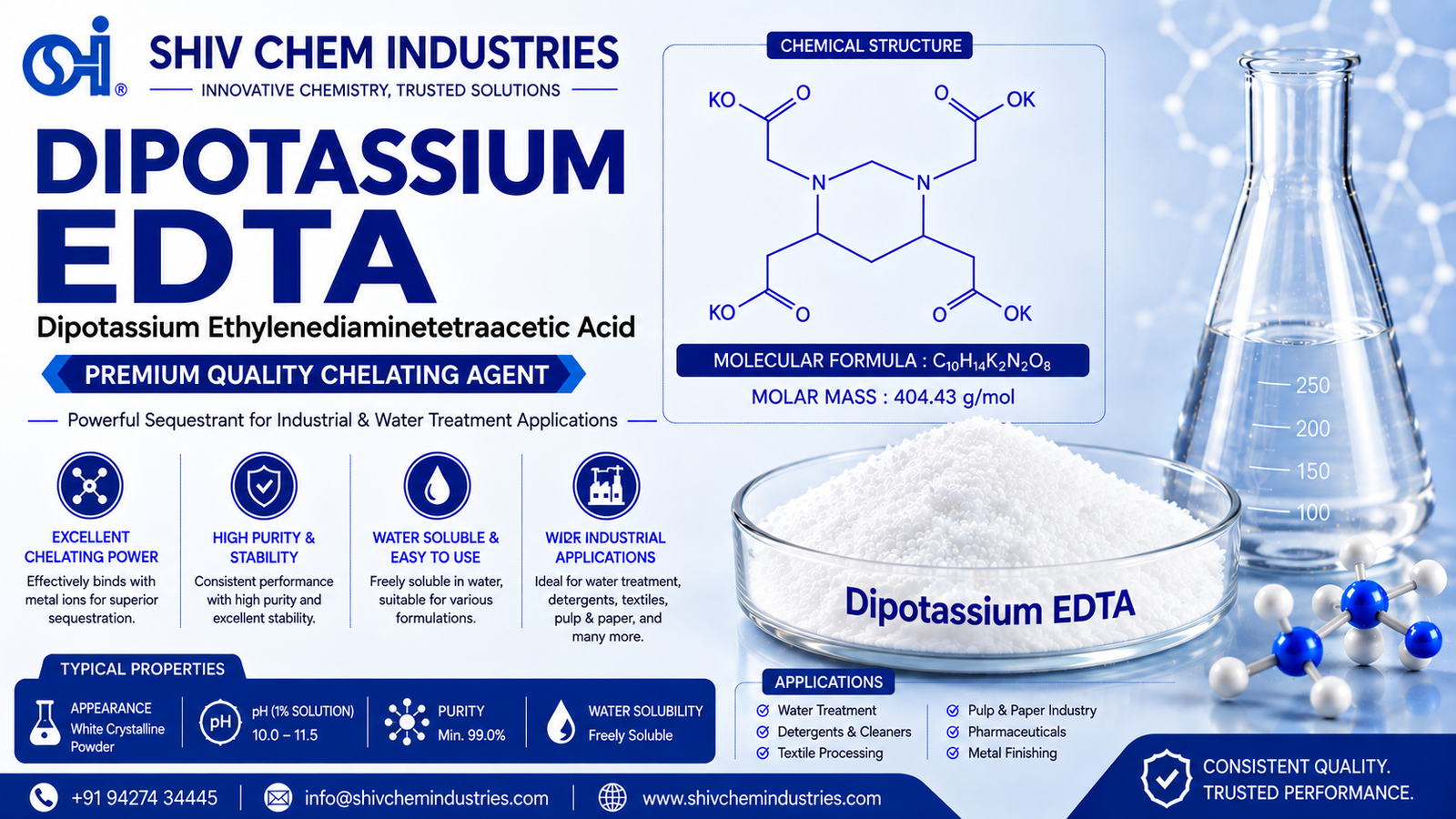
Dipotassium EDTA
Dipotassium EDTA, a vital salt of Ethylenediaminetetraacetic acid (EDTA), stands as a powerful chelating agent. Its ability to bind metal ions makes it indispensable across a multitude of industries, from agriculture and pharmaceuticals to cosmetics and water treatment. Understanding its properties, applications, and selection criteria is key for any business relying on its performance. SHIV CHEM INDUSTRIES, with over three decades of experience, is a recognized manufacturer dedicated to providing high-quality chelating agents, including Dipotassium EDTA, to meet diverse industrial demands.
What is Dipotassium EDTA?
Dipotassium EDTA, chemically known as the dipotassium salt of EDTA, is an organoamino polycarboxylic acid. EDTA itself is a hexadentate ligand, meaning it can form stable complexes with a wide range of metal ions by donating six pairs of electrons. The dipotassium salt is one of several forms of EDTA, each offering slightly different solubility and application characteristics. In essence, Dipotassium EDTA acts as a sequestering agent, effectively deactivating metal ions that can otherwise cause undesirable effects like precipitation, discoloration, or catalytic degradation in various formulations and processes.
The primary function of Dipotassium EDTA is to control the concentration of free metal ions. In industrial processes, these ions can act as catalysts for oxidation, lead to the formation of insoluble precipitates, or interfere with the efficacy of other ingredients. By forming stable, water-soluble complexes (chelates) with these metal ions, Dipotassium EDTA prevents them from participating in unwanted chemical reactions, thereby enhancing product stability, performance, and shelf-life.
Applications and Use Cases of Dipotassium EDTA
The versatility of Dipotassium EDTA allows it to be utilized across numerous sectors. Its ability to manage metal ions is critical for maintaining product integrity and process efficiency.
Agriculture
In agriculture, Dipotassium EDTA is crucial for micronutrient delivery. It chelates essential metal nutrients like iron, manganese, zinc, and copper, keeping them soluble and available for plant uptake in soil or foliar applications. This prevents nutrient deficiencies and promotes healthier crop growth. It is also used in herbicide and insecticide formulations to improve their stability and effectiveness.
Pharmaceuticals
The pharmaceutical industry uses Dipotassium EDTA as an excipient to stabilize drug formulations. It prevents the degradation of active pharmaceutical ingredients (APIs) that are susceptible to metal-catalyzed oxidation. It also helps in controlling the activity of metal ions in diagnostic agents and can be used in topical preparations.
Cosmetics and Personal Care
In cosmetic products such as creams, lotions, shampoos, and soaps, Dipotassium EDTA acts as a stabilizer. It prevents color changes, odor development, and texture degradation caused by trace metal impurities, thereby extending the product's shelf life and maintaining its aesthetic qualities.
Water Treatment
Dipotassium EDTA is employed in industrial water treatment to prevent scale formation and to remove metal ions that can interfere with processes or cause staining. It helps in maintaining the clarity and effectiveness of water used in various industrial applications.
Textiles and Dyes
In textile processing and dyeing, Dipotassium EDTA sequesters metal ions present in water or raw materials. These ions can otherwise lead to uneven dyeing, shade changes, and reduced color fastness. It ensures brighter, more consistent colors and improves the efficiency of bleaching and scouring processes.
Detergents and Cleaners
Detergents and cleaning agents benefit from Dipotassium EDTA by enhancing their cleaning power. It softens water by chelating calcium and magnesium ions, which can interfere with surfactant performance. This allows detergents to work more effectively, preventing soap scum and improving overall cleaning efficiency.
Paper and Rayon Manufacturing
In the production of paper and rayon, Dipotassium EDTA is used to control metal ion contamination. Trace metals can cause discoloration or degrade pulp quality during processing. EDTA's chelating action helps maintain product purity and desired characteristics.
Leather Industry
In leather processing, it helps to remove trace metal ions that can interfere with tanning and dyeing processes, ensuring a more uniform and higher-quality leather product.
Key Benefits of Using Dipotassium EDTA
Incorporating Dipotassium EDTA into industrial processes yields significant advantages:
- Enhanced Product Stability: Prevents degradation caused by metal-catalyzed reactions, extending shelf life.
- Improved Efficacy: Ensures active ingredients perform optimally by sequestering interfering metal ions.
- Color and Appearance Preservation: Maintains desired color and prevents discoloration in cosmetics, textiles, and other products.
- Process Efficiency: Reduces issues like scale formation, precipitation, and uneven reactions in manufacturing and treatment processes.
- Nutrient Availability: In agriculture, it makes essential micronutrients accessible to plants.
- Formulation Versatility: Compatible with a broad range of formulations and pH levels.
Buyer's Guide: Selecting the Right Dipotassium EDTA
Choosing the appropriate supplier and grade of Dipotassium EDTA is crucial for optimal performance and cost-effectiveness. Consider these factors:
Quality and Purity
Ensure the product meets industry standards for purity. Trace metal contaminants in the chelating agent itself can be counterproductive. Reputable manufacturers will have stringent quality control measures.
Solubility and Form
Dipotassium EDTA typically offers good water solubility. Verify that the specific grade aligns with your formulation's requirements, especially concerning concentration and pH.
Supplier Reliability
Partner with a manufacturer known for consistent product quality, timely delivery, and responsive customer support. Look for companies with a proven track record in producing chelating agents.
Technical Support
A knowledgeable supplier can offer guidance on the optimal use of Dipotassium EDTA in your specific application, helping troubleshoot potential issues and ensuring you achieve desired results.
SHIV CHEM INDUSTRIES: Your Trusted Partner for Dipotassium EDTA
With over 30 years of dedicated experience, SHIV CHEM INDUSTRIES has established itself as a leading manufacturer of high-quality chelating agents, including Dipotassium EDTA. Our commitment is rooted in chemical excellence and the provision of sustainable solutions that meet the rigorous demands of modern industries.
Our Vision: To be a globally recognized and trusted manufacturer of chelating agents, driven by innovation and a deep understanding of chemical applications. We aim to deliver superior products that empower our clients across diverse sectors.
Our Mission: We focus on precision manufacturing, adhering to strict quality control protocols at every stage. Our mission is to ensure the consistent delivery of superior chemical products, characterized by their reliability and performance, coupled with a commitment to timely delivery to support your operational needs.
Operating from our offices in Ahmedabad, Gujarat, and Mumbai, Maharashtra, we serve a broad spectrum of industries, including agriculture, pharmaceuticals, textiles, water treatment, cosmetics, detergents, and more. We understand the critical role Dipotassium EDTA plays in your processes, and we are dedicated to being a dependable source for your chemical requirements.
Frequently Asked Questions about Dipotassium EDTA
What makes Dipotassium EDTA a useful chelating agent?
Dipotassium EDTA is effective because it can form stable, water-soluble complexes with a wide range of metal ions. This 'chelating' action prevents these ions from causing unwanted reactions like oxidation, precipitation, or color changes in various products and processes.
How does Dipotassium EDTA benefit the agricultural sector?
In agriculture, it helps keep essential micronutrients (like iron, zinc, and manganese) soluble and available for plant absorption, preventing deficiencies and promoting healthy growth. It also enhances the stability of pesticides and herbicides.
Can Dipotassium EDTA be used in food products?
While EDTA and its salts are used in many applications, specific approvals and grades for direct food contact vary by region and intended use. It is primarily used in industrial applications such as cosmetics, pharmaceuticals, and agriculture.
What is the difference between Dipotassium EDTA and other EDTA salts?
The primary difference lies in their solubility and the specific metal ions they chelate most effectively under different pH conditions. Dipotassium EDTA generally offers good water solubility, making it suitable for aqueous formulations.
How should I store Dipotassium EDTA?
Dipotassium EDTA should be stored in a cool, dry place, away from direct sunlight and incompatible materials. Keep containers tightly closed to prevent moisture absorption and contamination.
Request Your Dipotassium EDTA Solution
Ensure the quality and performance of your products and processes with reliable Dipotassium EDTA from SHIV CHEM INDUSTRIES. With decades of manufacturing expertise and a commitment to excellence, we are equipped to meet your industrial chemical needs. Contact us today to discuss your specific requirements and learn how our high-quality chelating agents can benefit your operations.
Explore Our Products