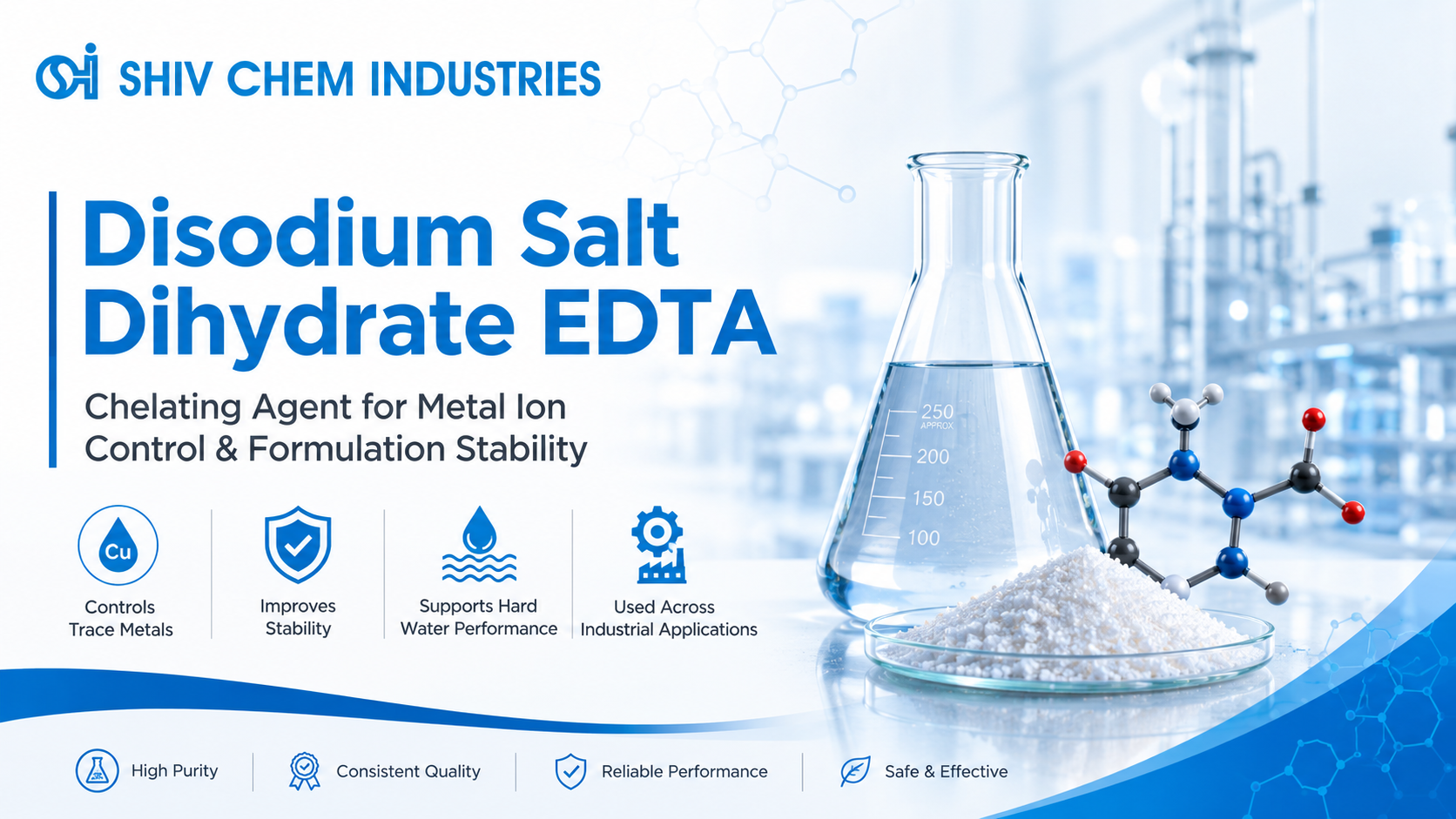
Disodium Salt Dihydrate EDTA
Disodium salt dihydrate EDTA is a vital chelating agent widely used in industrial and technical applications requiring precise metal ion control, enhanced stability, and consistent product performance. As a member of the EDTA chemical family, it effectively binds metal ions that can impact formulation quality, processing efficiency, shelf life, or final product behavior.
Even trace amounts of unwanted metal ions—from raw materials, water, equipment, or storage conditions—can affect product quality. Disodium salt dihydrate EDTA mitigates these effects by forming stable complexes with metal ions, ensuring controlled chemical performance and reliable outcomes across applications.
Shiv Chem Industries produces EDTA, NTA, DTPA acids, and their salts, along with Monochloroacetic Acid and Sodium Monochloro Acetate. These products serve diverse sectors, including agrochemical, paper, rubber, leather, agriculture, cosmetics, paint, rayon, electroplating, pharmaceuticals, soaps, detergents, and textiles.
Understanding Disodium Salt Dihydrate EDTA
Disodium salt dihydrate EDTA is the sodium salt form of ethylenediaminetetraacetic acid, known for chelating metal ions like calcium, magnesium, iron, copper, and other trace metals. Its dihydrate form contains two water molecules within its crystalline structure, enhancing practical handling and consistent performance in industrial formulations.
The chelating function prevents unwanted reactions caused by metal ions, which may otherwise lead to discoloration, precipitation, reduced activity, instability, or chemical changes. By binding these ions, disodium salt dihydrate EDTA maintains predictable product behavior and formulation quality.
Importance in Industrial Applications
Consistency is critical in industrial formulations across sectors such as agriculture, textiles, cleaning, water treatment, cosmetics, and chemical processing. Uncontrolled metal ions can compromise quality, while disodium salt dihydrate EDTA helps maintain stability.
In water-based systems, hardness minerals like calcium and magnesium may interfere with performance. EDTA binds these minerals to support smoother operation. In cleaning formulations, it enhances active ingredient efficiency in hard water. In chemical processing, it helps control reactions where trace metals might cause side effects. In personal care and cosmetic products, EDTA supports stability by minimizing metal-catalyzed changes. It also improves ingredient availability, stability, and compatibility in agricultural and industrial formulations.
Key Functional Properties
Disodium salt dihydrate EDTA is valued for targeted metal ion control rather than general additive use. Key properties include:
- Chelates metal ions in formulations
- Enhances stability in water-based systems
- Reduces interference from hardness minerals
- Prevents precipitation in specific applications
- Supports consistency across industrial formulations
Applications
Its versatility allows use in various industries where metal ion management is essential. Common applications include:
- Agrochemical formulations requiring chelation and stability
- Textile processing for consistent treatment quality
- Paper and pulp production to maintain process stability
- Rubber and chemical industry formulations
- Leather processing and chemical treatment stages
Quality Factors
Selecting high-quality disodium salt dihydrate EDTA is crucial. Key factors include:
- Purity and assay value
- Solubility characteristics
- Appearance and physical consistency
- Moisture content and dihydrate stability
Role in Agrochemical and Agricultural Formulations
In agrochemical and agriculture-related formulations, disodium salt dihydrate EDTA plays an important role in controlling unwanted metal ion interactions that may affect product stability, ingredient compatibility, and overall performance. Agricultural formulations often come into contact with water, minerals, micronutrients, active ingredients, and other chemical components. If metal ions remain uncontrolled, they may reduce formulation efficiency, cause precipitation, or affect the uniform behavior of the final product.
Disodium salt dihydrate EDTA helps manage these issues by chelating metal ions and supporting a more stable chemical environment.
Supporting Formulation Stability
Disodium salt dihydrate EDTA plays an important role in improving formulation stability by controlling unwanted metal ions that may enter through raw materials, process water, equipment contact, or storage conditions. Many industrial formulations contain water, active ingredients, preservatives, surfactants, dyes, minerals, and other chemical components. When these components come into contact with free metal ions, they may cause discoloration, cloudiness, sediment formation, reduced effectiveness, or changes in product appearance and performance.
By binding these metal ions, disodium salt dihydrate EDTA reduces their ability to create unwanted reactions within the formulation. This helps maintain better clarity, consistency, and chemical balance during processing, storage, and final use. Its stabilizing action is especially valuable in products that require longer shelf life, uniform appearance, and reliable performance under different water quality or handling conditions.
Conclusion
Disodium salt dihydrate EDTA is a versatile chelating agent that ensures metal ion control, formulation stability, and consistent industrial performance. Proper selection, handling, and application enable reliable results across soaps, detergents, textiles, agrochemicals, paper, leather, cosmetics, pharmaceuticals, electroplating, and other chemical industries. Shiv Chem Industries provides high-quality EDTA, NTA, DTPA, and related chemical products to meet industrial standards and application-specific requirements.