
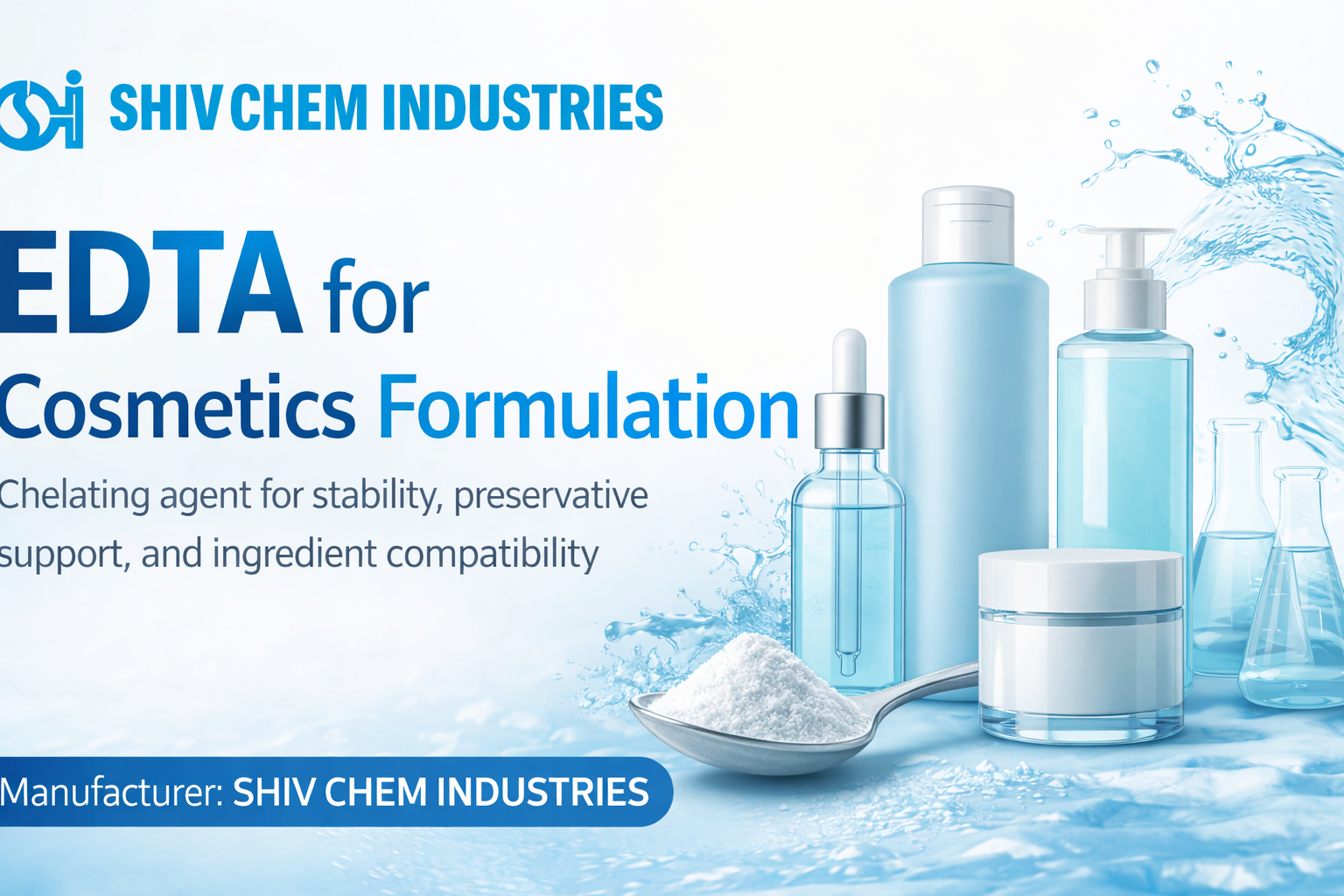
EDTA for Cosmetics Formulation
EDTA for Cosmetics Formulation
In the cosmetics and personal care industry, formulation stability is a key factor in overall product performance. From creams and shampoos to face cleansers and serums, manufacturers must ensure that products remain effective, visually appealing, and chemically stable throughout their shelf life. One of the most widely used ingredients for this purpose is EDTA. When discussing EDTA for cosmetics formulation, it refers to its practical role as a chelating agent that helps improve product quality, consistency, and compatibility with a wide range of cosmetic ingredients.
About SHIV CHEM INDUSTRIES
SHIV CHEM INDUSTRIES is a long-established manufacturer engaged in the production of EDTA, NTA, DTPA acid, and their salts, along with other specialty chemicals used across multiple industries. With decades of manufacturing experience, technical expertise, and dedicated production infrastructure, the company supports industrial users that require dependable chemical consistency and application-focused materials.
In cosmetics formulation, EDTA remains one of the most valuable ingredients where purity, controlled composition, and formulation performance are essential.
What Is EDTA in Cosmetics Formulation?
EDTA, or Ethylene Diamine Tetra Acetic Acid, is a chelating agent used in many cosmetic and personal care products. Its primary function is to bind with metal ions such as calcium, magnesium, iron, and copper that may be present in raw materials, water, or packaging interactions. Even in very small amounts, these trace metals can affect the appearance, fragrance, texture, color, and long-term stability of a cosmetic product.
When used correctly, EDTA helps formulators maintain product integrity by minimizing unwanted chemical reactions caused by metal contamination. This is especially important in formulations that contain surfactants, preservatives, botanical extracts, colorants, or fragrance compounds.
Why EDTA Is Important in Cosmetic Manufacturing
Cosmetic products are expected to remain stable and effective from the time they are manufactured until they are used by the consumer. However, trace metal ions can interfere with many ingredients and reduce overall formulation reliability. EDTA is added to help prevent this type of instability and support more predictable product behavior.
In practical cosmetic manufacturing, EDTA is commonly used because it helps maintain formulation balance without affecting the core purpose of the product. It works in the background, but its contribution is significant in helping ensure that the product performs as intended over time.
How EDTA Works in Cosmetic Formulations
The functional value of EDTA comes from its ability to capture and hold metal ions that may otherwise react with active or supportive ingredients in a cosmetic formula. Once these ions are bound, they are less likely to trigger oxidation, discoloration, precipitation, or breakdown of sensitive components.
This makes EDTA especially useful in products where ingredient interaction must be carefully controlled. It is often included in water-based systems, emulsions, cleansing products, and formulas where long-term visual and chemical stability is important.
Key Benefits of EDTA for Cosmetics Formulation
EDTA is not typically a headline ingredient on a cosmetic label, but it provides several behind-the-scenes benefits that directly influence product quality and user experience. Some of the most important formulation benefits include:
- Improved product stability
- Better preservative efficiency
- Reduced risk of discoloration
- Support for fragrance and color consistency
- Better compatibility with hard water
- Enhanced shelf-life performance
- Improved texture and visual clarity in certain formulations
Applications of EDTA in Cosmetic Products
EDTA is used in a wide range of cosmetic and personal care formulations because of its versatility and compatibility with many product types. Its role may vary depending on the formulation structure, water content, surfactant system, and preservation strategy. Common applications include:
- Face washes and cleansers
- Shampoos and conditioners
- Body washes and liquid soaps
- Moisturizers and lotions
- Creams and emulsions
- Face masks and scrubs
- Makeup removers
- Serums and gels
- Hair styling products
- Bath and personal hygiene products
Role of EDTA in Water-Based Cosmetic Systems
Water is one of the most common ingredients in cosmetics, but it can also be a source of mineral contamination. Hard water or untreated process water may introduce calcium, magnesium, and other ions that affect formulation behavior. EDTA helps control this challenge by binding these ions before they interfere with surfactants, emulsifiers, preservatives, or active ingredients.
This is especially relevant in cleansing products, where water interaction is central to product performance. In shampoos, body washes, and facial cleansers, EDTA may help improve foaming consistency and formulation stability when used under controlled manufacturing conditions.
EDTA and Preservative System Support
Another important function of EDTA in cosmetics formulation is its supportive role in preservation systems. While EDTA is not a preservative by itself, it can help improve the effectiveness of certain preservatives by reducing the impact of metal ions that might otherwise destabilize the formulation.
This is particularly useful in cosmetic products where microbial control is essential and preservative systems must remain effective throughout the product lifecycle. Formulators often include EDTA to support broader formulation stability and help maintain preservation performance under real-world storage conditions.
EDTA in Skin Care and Personal Care Products
In skin care, the formulation environment can be especially sensitive due to the presence of botanical extracts, vitamins, actives, and emulsified systems. These ingredients may react with trace metals over time, causing changes in color, odor, or effectiveness. EDTA helps reduce this risk and supports a cleaner, more controlled formulation structure.
Its use in personal care products is also common because these products are frequently exposed to repeated opening, moisture, bathroom storage conditions, and varying water quality. EDTA helps provide additional formulation reliability in such environments.
Why Raw Material Quality Matters
For any cosmetic ingredient, performance depends not only on the chemical name but also on the manufacturing quality, consistency, and purity of the supplied material. This is particularly important for EDTA, where application success depends on reliable formulation behavior.
SHIV CHEM INDUSTRIES manufactures EDTA and related specialty chemicals with a long-standing focus on quality-controlled production. The company has been active since 1987 and serves industries that require dependable chemical performance across technical applications. With an established manufacturing setup and experienced leadership, the company supports customers who value consistency in supply and composition. When cosmetic manufacturers or formulation developers source EDTA, they typically look for:
- Consistent chemical composition
- Reliable batch-to-batch quality
- Suitable application compatibility
- Dependable manufacturing standards
- Technical understanding of industrial use
Factors to Consider Before Using EDTA in Cosmetic Development
Selecting EDTA for a cosmetic formulation should always be based on product type, ingredient compatibility, formulation objectives, and intended performance. It should be used with proper technical understanding and in line with formulation design requirements. Before including EDTA in a product, formulators usually review:
- Water quality used in production
- Type of surfactants or emulsifiers present
- Sensitivity of active ingredients
- Preservation system compatibility
- Final product pH range
- Texture and appearance expectations
- Stability testing requirements
EDTA and Long-Term Formulation Stability
One of the strongest reasons EDTA remains relevant in cosmetic chemistry is its contribution to long-term stability. Cosmetic products are expected to remain attractive and functional across transport, storage, retail display, and end-user handling. During this lifecycle, even minor ingredient interactions can affect product quality.
EDTA helps reduce the risk of these issues by preventing metal ions from interfering with the formula. This contributes to a more stable product profile, which is especially important for brands that want dependable performance across multiple batches and product lines.
How EDTA Supports Better Cosmetic Product Performance
Consumers may not notice EDTA directly, but they often notice the benefits it helps preserve. A product that remains clear, smooth, stable, and consistent over time reflects the role of carefully selected support ingredients. EDTA plays exactly that kind of supporting role in many formulations.
Its value lies in improving the chemical environment of the product so that primary ingredients can perform more effectively. Whether the formulation is designed for cleansing, moisturizing, conditioning, or skin care support, EDTA can contribute to a more controlled and dependable final product.
Frequently Asked Questions
Conclusion
EDTA for cosmetics formulation remains an important functional ingredient in modern personal care manufacturing. Its ability to bind trace metal ions helps improve formulation stability, support preservative systems, protect sensitive ingredients, and maintain product consistency across multiple applications. From cleansers and shampoos to creams and skin care systems, EDTA continues to serve a practical and technically valuable role.
With decades of manufacturing experience in EDTA and related specialty chemicals, SHIV CHEM INDUSTRIES supports industries that depend on reliable chemical quality and application-focused production. In cosmetics formulation, where consistency and stability are essential, EDTA remains a widely trusted solution for better-performing products.
Get In Touch

Get In Touch
C-1/B, 1307/10, Road-G, Lane-5, Phase-IV, GIDC, Naroda, Ahmedabad-382330, Gujarat, INDIA.
Chelateshivchem@yahoo.co.in
info@shivchem.com
+91 9825312613, +91 98255 77277
079 22823447, +91 9558877277, +91 9574577277
Links
PRODUCTS
SHIV CHEM INDUSTRIES