
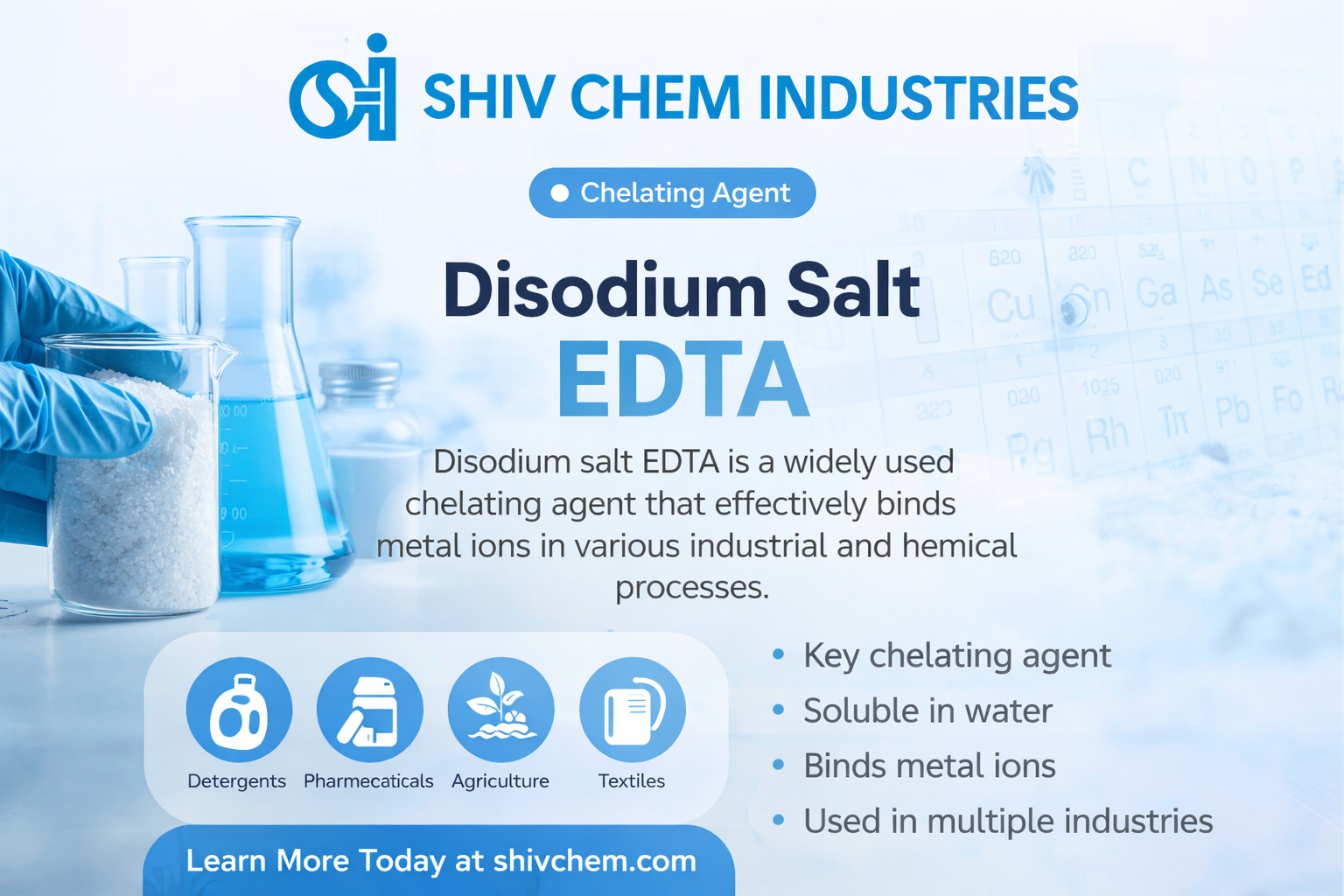
Disodium Salt EDTA
Disodium Salt EDTA
Disodium salt EDTA is a widely used chelating agent known for its ability to bind metal ions effectively in various industrial and chemical processes. It is typically available as a white, free-flowing powder with high solubility in water, making it suitable for diverse formulations. This compound plays a crucial role in stabilizing chemical systems by preventing unwanted reactions caused by metal impurities. Its consistent composition and predictable performance have made it a preferred choice in industries that require controlled and stable chemical environments.
Chemical Overview
Understanding the Chemical Composition and Structure
Disodium salt EDTA is derived from ethylenediaminetetraacetic acid through a neutralization process that enhances its solubility and practical usability. The compound has a well-defined molecular structure that enables it to form stable complexes with metal ions such as calcium, magnesium, and iron. This chelation process is essential for maintaining chemical balance in systems where metal ions can interfere with reactions or affect product quality. Its molecular weight, purity level, and chelation value contribute to its reliability in both laboratory and industrial applications.
Properties
Physical and Chemical Properties
The effectiveness of disodium salt EDTA is supported by its stable physical and chemical characteristics. It appears as a white powder with high purity and remains stable under standard storage conditions. The compound dissolves easily in water, forming a clear solution that performs efficiently across a moderate pH range. Its strong chelation capacity allows it to bind metal ions effectively, ensuring consistent and improved outcomes in processes that demand precision.
Production
Manufacturing Process and Quality Control
The production of disodium salt EDTA involves the reaction of EDTA acid with controlled quantities of water and alkaline substances under specific temperature conditions. This process ensures uniform particle size, purity, and consistent chemical composition. Strict quality control measures are maintained throughout manufacturing to ensure stability in active content and performance. The final product is tested for key parameters such as solubility, pH level, and chelation value to meet established industrial standards.
Core Function
Role of Disodium Salt EDTA as a Chelating Agent
One of the primary functions of disodium salt EDTA is its role as a chelating or sequestering agent. It binds with metal ions to form stable complexes, preventing them from reacting with other components in a system. This function is especially important in processes where metal contamination can impact product quality, efficiency, or stability. By controlling metal ion activity, it enhances detergent performance, improves dyeing consistency in textiles, and maintains clarity in water-based formulations.
Applications
Industrial Applications Across Multiple Sectors
Disodium salt EDTA is widely used across multiple industries due to its versatility and reliable performance. Its applications include:
- Textile processing, including bleaching, dyeing, and scouring, where it ensures uniform color and reduces metal interference
- Soap and detergent formulations, where it enhances cleaning efficiency by binding hardness-causing ions
- Pharmaceutical processes, where it acts as a stabilizing and synergistic agent
- Paper and pulp manufacturing, where it supports brightness and process consistency
- Electroplating operations, where it helps maintain metal ion balance
- Rubber and polymer industries, where it supports controlled chemical reactions
- Photography and imaging processes, where it helps maintain solution stability
- Leather processing, where it aids in uniform treatment
- Agricultural formulations, where it improves nutrient availability
- Industrial cleaning solutions, where it improves performance in removing metal residues
Safety
Handling and Safety Considerations
Proper handling of disodium salt EDTA is important to ensure safety and maintain product integrity. The compound may cause irritation if it comes into contact with skin or eyes, so appropriate protective equipment should be used during handling. Standard safety practices, including the use of gloves, goggles, and protective clothing, should be followed. In case of accidental exposure, immediate washing with water is recommended, followed by cleaning with mild soap if required. Following safe handling practices helps minimize risks and ensures a safe working environment.
Storage
Storage and Stability Guidelines
Disodium salt EDTA should be stored in a cool and dry environment to maintain its quality and effectiveness. Adequate ventilation in the storage area helps prevent moisture accumulation. The product should be kept away from direct sunlight, heat sources, and humid conditions, as these factors can affect stability. It is typically stored in polyethylene or similar containers that protect it from contamination and moisture. Proper storage ensures long shelf life and consistent performance.
Reliability
Why Disodium Salt EDTA Remains Widely Used
The continued use of disodium salt EDTA across industries is driven by its consistent performance, versatility, and compatibility with a wide range of chemical systems. It provides a reliable solution for controlling metal ions, improving process efficiency, and maintaining product stability. Its ability to perform effectively under different conditions makes it a valuable component in both large-scale industrial operations and specialized formulations.
FAQ
Frequently Asked Questions

Get In Touch
C-1/B, 1307/10, Road-G, Lane-5, Phase-IV, GIDC, Naroda, Ahmedabad-382330, Gujarat, INDIA.
Chelateshivchem@yahoo.co.in
info@shivchem.com
+91 9825312613, +91 98255 77277
079 22823447, +91 9558877277, +91 9574577277
Links
PRODUCTS
SHIV CHEM INDUSTRIES