
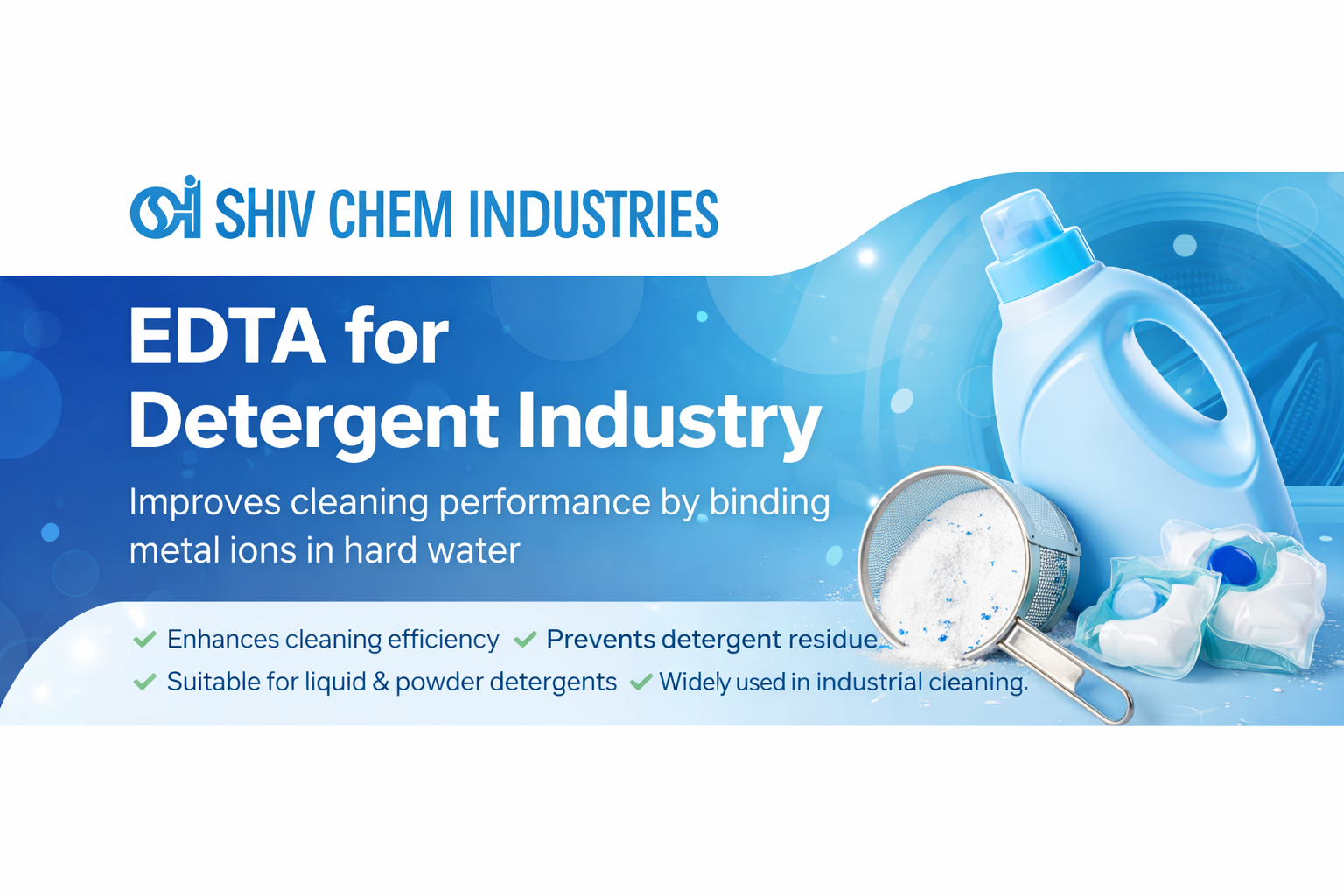
EDTA for Detergent Industry
EDTA for Detergent Industry
In the detergent manufacturing sector, maintaining consistent cleaning performance across varying water conditions is a critical requirement. EDTA for detergent industry applications plays a vital role in achieving this consistency by acting as an effective chelating agent. It binds with metal ions such as calcium and magnesium, which are commonly present in hard water and can interfere with detergent performance.
The use of EDTA in detergent formulations improves the overall efficiency of cleaning agents by preventing unwanted chemical reactions that reduce effectiveness. This makes it an important component in both household and industrial detergent products where reliable performance is required under different environmental conditions.
As industries continue to focus on performance stability and formulation optimization, EDTA remains widely used due to its proven chemical properties and compatibility with a broad range of detergent ingredients.
Understanding the Role of EDTA in Detergent Formulations
EDTA, or Ethylene Diamine Tetra Acetic Acid, is a chelating agent known for its ability to form stable complexes with metal ions. In detergent formulations, its primary function is to control the negative effects of water hardness.
When detergents are used in hard water, dissolved minerals such as calcium and magnesium can react with cleaning agents, reducing their ability to remove dirt and stains. EDTA prevents this by binding to these metal ions, allowing the detergent to function more effectively.
This interaction enhances the overall cleaning process and ensures that detergents maintain consistent performance across different water conditions.
Key Functional Benefits of EDTA in Detergents
The effectiveness of EDTA in detergent formulations can be understood through its core functional benefits:
- Binds with calcium and magnesium ions present in hard water
- Prevents interference with surfactants and cleaning agents
- Enhances overall cleaning efficiency
- Improves formulation stability and shelf life
- Reduces residue and scaling during washing processes
These benefits make EDTA a widely accepted component in detergent manufacturing, especially where consistent performance is required.
Applications of EDTA in Different Types of Detergents
EDTA is used across a wide range of detergent applications due to its versatility and effectiveness. While its role remains consistent, formulation requirements may vary depending on the type of detergent.
- Laundry detergents for improved stain removal and fabric care
- Industrial cleaning agents for heavy-duty applications
- Dishwashing detergents for effective grease and mineral removal
- Liquid detergents where formulation stability is critical
- Powder detergents requiring enhanced performance in hard water
In each of these applications, EDTA contributes to maintaining product efficiency and reliability, making it a key ingredient in modern detergent chemistry.
How EDTA Improves Cleaning Efficiency
The performance of a detergent depends largely on its ability to interact effectively with dirt, grease, and stains. However, the presence of metal ions in water can disrupt this interaction. EDTA addresses this issue by isolating these ions, ensuring that cleaning agents can perform without interference.
By preventing the formation of insoluble compounds, EDTA helps maintain the activity of surfactants. This results in better soil removal, improved rinsing, and reduced residue on surfaces or fabrics.
The outcome is a more efficient cleaning process that delivers consistent results, regardless of water quality or environmental conditions.
Industrial Relevance of EDTA in Detergent Manufacturing
The detergent industry depends on chemical consistency and predictable performance. EDTA supports these requirements by providing a reliable solution for managing water hardness and maintaining formulation integrity.
In industrial applications, where cleaning processes often operate under controlled conditions, EDTA helps ensure consistent outcomes. It also reduces the risk of equipment scaling and residue buildup, which can affect operational efficiency.
This makes EDTA a valuable component not only in product formulation but also in supporting overall process efficiency in manufacturing environments.
Factors to Consider When Using EDTA in Detergents
When incorporating EDTA into detergent formulations, manufacturers typically consider several important factors to achieve optimal performance:
- Compatibility with other chemical ingredients
- Required concentration based on water hardness levels
- Desired stability and shelf life of the product
- Type of detergent (liquid, powder, or industrial)
- Regulatory and environmental considerations
Proper selection and usage of EDTA help achieve the desired balance between performance, stability, and formulation efficiency.
Future Outlook of EDTA in the Detergent Industry
As the detergent industry continues to evolve, the demand for effective and reliable chemical solutions remains strong. EDTA continues to play an important role due to its ability to enhance cleaning performance and maintain formulation stability.
With increasing emphasis on efficiency, consistency, and process optimization, EDTA remains relevant in both conventional and advanced detergent formulations. Its adaptability and effectiveness ensure its continued use across various cleaning applications.
Frequently Asked Questions
Conclusion
EDTA for detergent industry applications plays a fundamental role in improving cleaning efficiency, maintaining formulation stability, and ensuring consistent performance across different water conditions. Its ability to bind metal ions and prevent interference with active ingredients makes it an essential component in modern detergent formulations.
By supporting improved cleaning outcomes and reducing formulation challenges, EDTA contributes to the overall effectiveness and reliability of detergents used in both household and industrial environments. As the demand for high-performance cleaning solutions continues to grow, the importance of EDTA in the detergent industry remains significant.
Get In Touch

Get In Touch
C-1/B, 1307/10, Road-G, Lane-5, Phase-IV, GIDC, Naroda, Ahmedabad-382330, Gujarat, INDIA.
Chelateshivchem@yahoo.co.in
info@shivchem.com
+91 9825312613, +91 98255 77277
079 22823447, +91 9558877277, +91 9574577277
Links
PRODUCTS
SHIV CHEM INDUSTRIES