
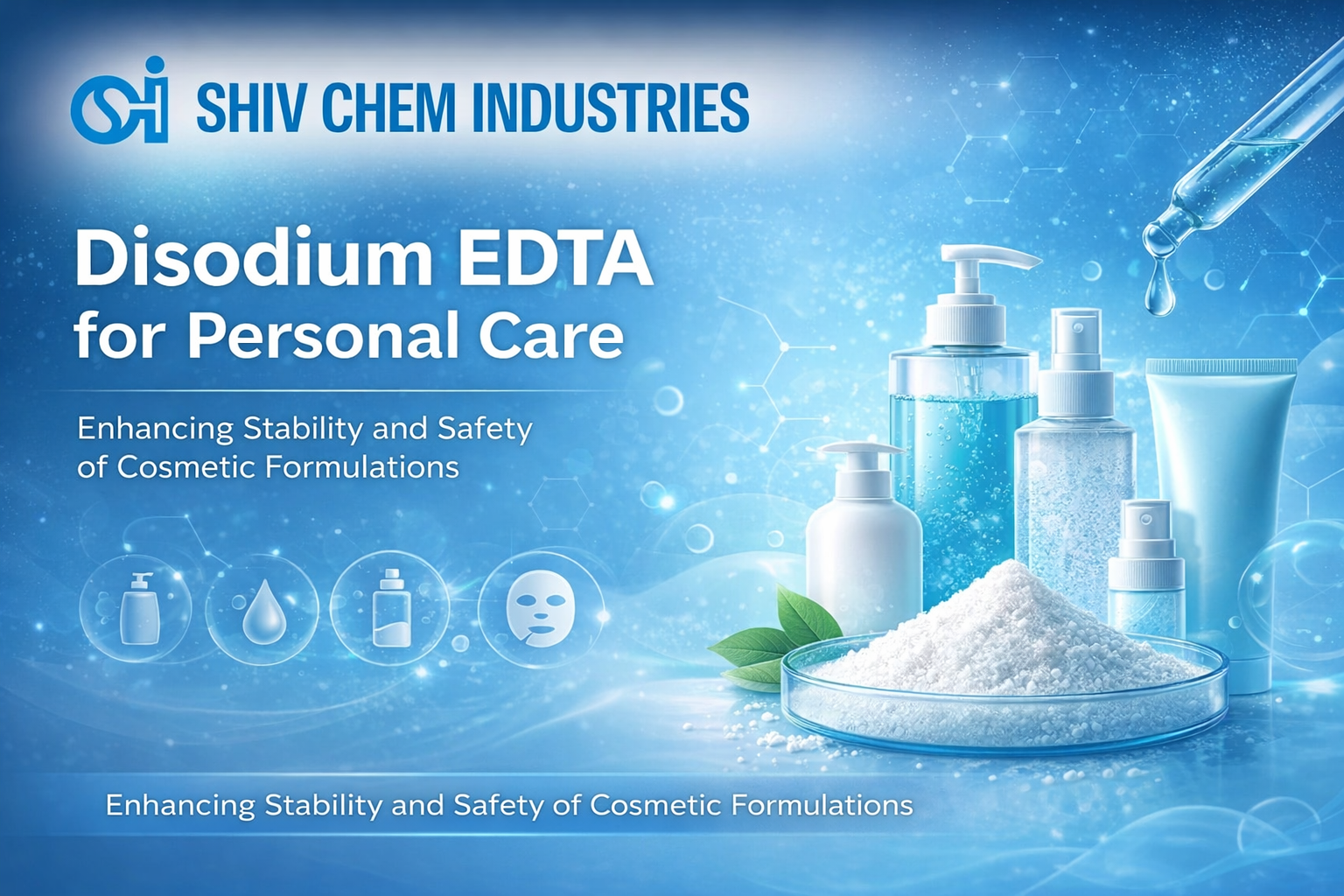
Disodium EDTA for Personal Care
Disodium EDTA for Personal Care
Personal care products are formulated using carefully selected ingredients that help ensure safety, stability, and consistent product performance.
One commonly used ingredient in cosmetic and personal care formulations is Disodium EDTA. This compound primarily functions as a chelating agent, helping manufacturers maintain formulation stability by controlling the effects of metal ions that may be present in water, raw materials, or processing environments.
Disodium EDTA for personal care plays an important role in improving the reliability and shelf stability of cosmetic formulations. Even trace amounts of metal contaminants can influence the performance, color, fragrance stability, and preservation system of personal care products. By binding with these unwanted metal ions, Disodium EDTA helps support the stability and consistency of formulations used in various skincare, haircare, and hygiene products.
The use of chelating agents has therefore become a standard practice in the formulation of many personal care products where product quality, formulation stability, and ingredient compatibility are important considerations.
Understanding the Role of Disodium EDTA in Personal Care Formulations
Disodium EDTA is the disodium salt form of ethylenediaminetetraacetic acid, a compound widely recognized for its chelation properties. In personal care formulations, chelation refers to the ability of a substance to bind metal ions such as calcium, iron, magnesium, or copper that could otherwise interfere with formulation stability.
Metal ions can enter cosmetic formulations through water, raw materials, manufacturing equipment, or packaging components. Even in small concentrations, these ions may trigger unwanted chemical reactions that can affect product color, fragrance, texture, or preservation efficiency.
When Disodium EDTA is incorporated into a formulation, it forms stable complexes with these metal ions, preventing them from reacting with other ingredients. This protective action helps maintain the intended performance and stability of the finished product.
Because of its effectiveness and compatibility with a wide range of ingredients, Disodium EDTA is widely incorporated into personal care products as a formulation support ingredient.
How Disodium EDTA Improves Cosmetic Product Stability
Formulation stability is one of the most important aspects of cosmetic manufacturing. Personal care products must maintain their appearance, fragrance, texture, and effectiveness throughout their intended shelf life. Disodium EDTA contributes to this stability by preventing metal-catalyzed reactions that could otherwise degrade sensitive ingredients.
Many cosmetic formulations contain natural extracts, fragrances, oils, surfactants, and preservatives that may be sensitive to oxidation or chemical changes triggered by metal ions. By binding these ions, Disodium EDTA helps reduce the risk of oxidation reactions that can cause discoloration, rancidity, or reduced product effectiveness.
Another important function of Disodium EDTA is its ability to support the efficiency of preservatives. Certain metal ions can reduce the effectiveness of antimicrobial preservatives used in cosmetic products. By removing these interfering ions, Disodium EDTA helps maintain the protective action of the preservation system, supporting product safety during storage and use.
The presence of Disodium EDTA in formulations therefore contributes to improved shelf life and more consistent product quality.
Manufacturing Process of Disodium EDTA
Disodium EDTA is typically produced through a controlled chemical reaction involving EDTA acid, purified water, and alkaline compounds under carefully regulated temperature conditions. The resulting compound is then processed into a free-flowing powder that dissolves readily in water.
The powder form of Disodium EDTA is particularly suitable for cosmetic manufacturing because it allows accurate dosing during formulation development. Once dissolved, the compound disperses evenly within the formulation, ensuring consistent chelation performance throughout the product.
The chemical structure of Disodium EDTA provides multiple binding sites that allow it to form stable complexes with metal ions. This molecular characteristic makes it an effective chelating agent across a wide range of formulation environments.
Key Characteristics of Disodium EDTA Used in Personal Care Products
Disodium EDTA used in personal care manufacturing generally possesses several technical characteristics that support its effectiveness in formulations.
- White free-flowing powder
- High purity chelating compound
- Readily soluble in water
- Stable across a wide pH range
- Effective metal ion sequestration capability
- Compatible with many cosmetic ingredients
These characteristics allow formulators to incorporate Disodium EDTA into a wide variety of product types without significantly affecting the texture or appearance of the final formulation.
Applications of Disodium EDTA in Personal Care Products
Disodium EDTA is widely used across multiple categories of personal care and cosmetic products where formulation stability and ingredient compatibility are essential.
- Shampoos and hair cleansing formulations
- Liquid soaps and body washes
- Facial cleansers and skincare products
- Creams and lotions
- Sunscreen products
- Cosmetic emulsions
- Makeup and foundation formulations
- Personal hygiene products
- Bath and shower formulations
- Skin treatment products
In these applications, Disodium EDTA functions within the formulation to control metal ion interactions that could otherwise affect product stability.
Why Chelating Agents Are Important in Cosmetic Manufacturing
Chelating agents such as Disodium EDTA play an important supporting role in cosmetic formulation science. While they may not directly influence the primary function of a cosmetic product, their presence helps maintain the performance of other ingredients.
Cosmetic manufacturers frequently rely on purified water as a major component of formulations. However, water may still contain trace minerals such as calcium and magnesium that can interfere with formulation performance. Chelating agents help neutralize the effects of these minerals.
Chelation also helps prevent unwanted interactions between metal ions and surfactants, fragrances, pigments, and active ingredients. This ensures that the intended formulation characteristics remain consistent during production, packaging, and long-term storage.
Because of these functions, Disodium EDTA has become a widely accepted ingredient in many cosmetic and personal care manufacturing processes.
Handling and Safety Considerations
Handling chemical ingredients used in cosmetic manufacturing requires adherence to proper safety procedures and responsible storage practices. Disodium EDTA is typically handled in powder form, and appropriate precautions should be followed during manufacturing operations.
Personnel handling the material generally use protective equipment such as gloves, safety goggles, and protective footwear. These precautions help minimize potential irritation to the skin or eyes that may occur during direct exposure.
In manufacturing environments, accidental spillage can usually be managed by washing the affected area with sufficient amounts of water. Proper workplace hygiene practices and safe handling procedures help ensure the safe use of the material in industrial settings.
Storage and Packaging Practices
Maintaining product quality requires proper storage conditions for raw materials used in cosmetic production. Disodium EDTA is typically stored in cool, dry environments with adequate ventilation.
Exposure to excessive moisture, direct sunlight, or high temperatures can affect the stability of chemical materials during storage. For this reason, sealed packaging and controlled storage conditions are recommended.
Common packaging formats for Disodium EDTA include industrial bags designed to protect the powder from moisture exposure. Materials such as polyethylene or high-density polymer liners are often used to help maintain product integrity during storage and transportation.
Consistent storage practices help preserve the purity and performance characteristics of the product until it is used in manufacturing processes.
Quality Considerations in Personal Care Ingredient Selection
Cosmetic manufacturers place strong emphasis on ingredient quality, purity, and consistency when selecting raw materials. The quality of formulation ingredients directly influences the performance, stability, and safety profile of the final product.
Disodium EDTA used in personal care manufacturing is typically produced according to strict quality control standards. Analytical testing helps ensure that parameters such as purity level, chelation value, pH range, and solubility meet established specifications.
Reliable ingredient sourcing and proper quality verification enable manufacturers to maintain consistent product performance across different production batches.
Conclusion
Disodium EDTA for personal care plays an important supporting role in modern cosmetic formulation. Its ability to bind metal ions helps protect ingredients from unwanted reactions that may affect product stability, appearance, and overall performance.
By supporting preservative systems, preventing oxidation reactions, and maintaining ingredient compatibility, Disodium EDTA contributes to the reliability of a wide range of personal care products. Its compatibility with various formulation types and its effectiveness as a chelating agent make it a commonly used ingredient in cosmetic manufacturing processes.
As personal care formulations continue to evolve with new ingredients and more complex compositions, chelating agents such as Disodium EDTA remain essential in maintaining formulation stability and product quality.
Frequently Asked Questions

Get In Touch
C-1/B, 1307/10, Road-G, Lane-5, Phase-IV, GIDC, Naroda, Ahmedabad-382330, Gujarat, INDIA.
Chelateshivchem@yahoo.co.in
info@shivchem.com
+91 9825312613, +91 98255 77277
079 22823447, +91 9558877277, +91 9574577277
Links
PRODUCTS
SHIV CHEM INDUSTRIES