
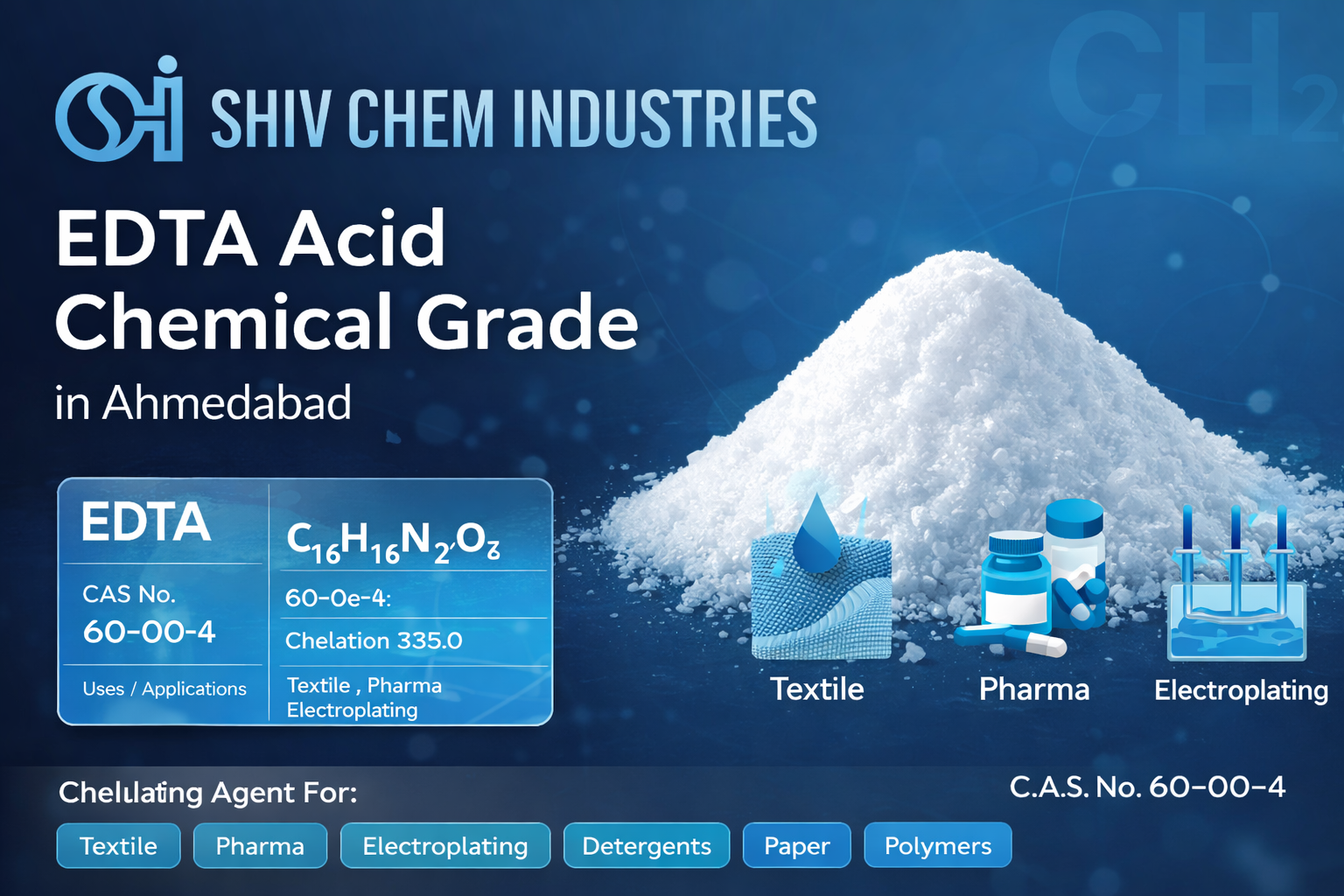
EDTA Acid Chemical Grade
EDTA Acid Chemical Grade
in Ahmedabad
Industrial manufacturing environments require reliable chelating agents to maintain formulation stability, process control, and consistent product quality. EDTA Acid Chemical Grade in Ahmedabad is widely used across industries where effective metal ion control is essential.
Shiv Chem Industries — EDTA Acid Manufacturer
From textile processing and pharmaceuticals to electroplating and polymerization, the demand for high-purity EDTA continues to grow within Gujarat's industrial ecosystem.
Shiv Chem Industries, established in 1987 and located in Phase-IV, GIDC Naroda, Ahmedabad, manufactures EDTA Acid (Edetic Acid) for domestic and export markets. The company follows structured production systems and controlled quality procedures to ensure consistent chemical performance across applications. With decades of manufacturing experience, it supplies EDTA-based chelating agents to industries that require dependable and standardized material quality.
Understanding EDTA Acid (Edetic Acid)
EDTA Acid, chemically known as Ethylenediaminetetraacetic Acid, is a synthetic amino acid that functions as a chelating or sequestering agent. It has the chemical formula C??H??N?O? and C.A.S. No. 60-00-4. In its pure form, it appears as a white, free-flowing powder with a molecular weight of 292.24.
As a hexadentate ligand, EDTA effectively binds with metal ions such as calcium, magnesium, iron, copper, and other trace metals. This chelation capability enables it to control unwanted metal contamination in industrial processes. By forming stable complexes with metal ions, EDTA helps prevent precipitation, oxidation, scaling, and process instability.
The chemical grade EDTA manufactured in Ahmedabad is characterized by the following specifications:
Technical Specifications
| C.A.S. No. | 60-00-4 |
| Chemical Formula | C??H??N?O? |
| Physical Appearance | White powder |
| Active Content | 99.0% ± 1.0% |
| Chelation Value | Minimum 335.0 |
| pH (0.05% w/v) | 2.0 to 3.0 |
The product is insoluble in water in its acid form but forms a clear, colorless solution when dissolved in 20% sodium hydroxide solution. This controlled solubility behavior is important for many industrial formulation processes.
Manufacturing and Quality Considerations
The production of EDTA Acid Chemical Grade involves raw materials such as monochloroacetic acid, sodium carbonate, sodium hydroxide, ethylene diamine, and hydrochloric acid. Careful control of reaction parameters, purification stages, and drying processes ensures that the final product meets industrial standards for active content and chelation value.
In certain international manufacturing routes, EDTA may be produced using formaldehyde, ethylene diamine, and sodium cyanide or hydrogen cyanide. These routes can introduce trace levels of Nitrilo Tri Acetic acid as an impurity. Therefore, manufacturing systems that emphasize impurity control are essential to maintain chemical integrity, especially for sensitive applications such as pharmaceuticals and electroplating.
Routine testing of active content, pH range, and chelation value supports consistent performance in downstream processes. For industries operating in Ahmedabad and across Gujarat, sourcing EDTA from a manufacturer with established process control enhances operational stability and product reliability.
Industrial Applications of EDTA Acid Chemical Grade
EDTA Acid Chemical Grade in Ahmedabad is used across multiple industrial sectors where metal ion sequestration improves process efficiency and product quality.
Textile Industry
In textile bleaching, dyeing, kier boiling, and scouring, EDTA binds hardness-causing metal ions present in water. This reduces uneven dyeing, prevents spotting, and minimizes fabric damage. Effective metal control improves color consistency and enhances the final finish of textiles.
Soap and Detergent Manufacturing
In detergent formulations, EDTA improves cleaning efficiency by neutralizing calcium and magnesium ions found in hard water. This allows surfactants to function more effectively and enhances overall washing performance.
Pharmaceutical Applications
In pharmaceutical processing, EDTA functions as:
- Antioxidant synergist
- Antibacterial synergist
- Anticoagulant stabilizer
By controlling trace metal contamination, it supports formulation stability and helps maintain product shelf life under controlled conditions.
Paper and Pulp Processing
In paper manufacturing, EDTA assists in controlling metal-induced discoloration and scaling during bleaching operations. This helps maintain brightness stability and reduces equipment fouling.
Electroplating and Surface Treatment
In electroplating applications, EDTA stabilizes metal ions within plating baths. It supports controlled deposition rates and improves coating quality by maintaining balanced solution chemistry.
Additional sectors where EDTA Acid Chemical Grade is widely used include:
In each of these applications, the ability of EDTA to form stable metal complexes contributes to cleaner, more controlled, and predictable industrial operations.
Safety & Compliance
Storage and Handling Guidelines
Proper handling and storage are essential to maintain product quality and workplace safety. EDTA and concentrated solutions may cause irritation to the eyes and skin. Industrial facilities should implement appropriate safety protocols during handling.
Personnel handling EDTA Acid Chemical Grade should wear protective goggles, gloves, and safety footwear. The material should be handled carefully, and packaging should not be lifted using hooks to prevent damage. In case of spillage, the affected area should be washed thoroughly with ample water.
If skin contact occurs, washing with water followed by neutral soap is recommended. Medical attention should be sought if irritation persists.
The product should be stored in a cool, dry, and well-ventilated area. Containers must be kept away from heat sources, direct sunlight, and moisture. EDTA is typically stored in containers made of or lined with polyethylene, polypropylene, or high-density polyethylene to prevent contamination and moisture ingress.
Packaging Standards
EDTA Acid Chemical Grade in Ahmedabad is commonly packed in 25 kg HDPE bags or paper bags with an inner polyethylene liner. This dual-layer packaging helps protect the product from moisture exposure during transportation and storage.
Customized packaging solutions may also be arranged to meet specific industrial bulk handling requirements. Appropriate packaging ensures product integrity from the manufacturing facility to the end-user site.
Why Ahmedabad is a Key Hub for EDTA Acid Supply
Ahmedabad, particularly industrial zones such as GIDC Naroda, has developed into a significant chemical manufacturing cluster in Gujarat. The region supports a broad range of downstream industries, including textiles, pharmaceuticals, dyes, pigments, electroplating, and polymers.
Access to technical manpower, established supply chains, and strong industrial infrastructure makes Ahmedabad a strategic location for chemical-grade EDTA production. Proximity to major textile and chemical processing units reduces logistical complexity and supports consistent supply.
For industries seeking EDTA Acid Chemical Grade in Ahmedabad, sourcing from a manufacturer within the same industrial ecosystem facilitates better coordination, technical communication, and timely material availability.
Quality Parameters Buyers Should Evaluate
When sourcing EDTA Acid Chemical Grade, buyers should assess key technical parameters to ensure suitability for their specific process requirements:
Evaluating these parameters helps ensure reliable performance in industrial environments where process deviations can directly impact final product quality.
EDTA Acid vs. EDTA Salts
While EDTA Acid is the base chelating compound, it is also available in salt forms such as disodium, trisodium, and tetrasodium EDTA. The choice between acid and salt forms depends on application requirements, solubility preferences, and formulation compatibility.
EDTA Acid Chemical Grade is often selected for applications requiring controlled neutralization or specific formulation chemistry. Industrial users should evaluate compatibility with existing process conditions before final selection.
Frequently Asked Questions
Common Questions About EDTA Acid Chemical Grade
EDTA Acid Chemical Grade is used as a chelating agent to control metal ions in textile processing, pharmaceuticals, electroplating, detergents, paper manufacturing, and polymerization processes across Ahmedabad's industrial sectors.
In its pure acid form, EDTA is insoluble in water. However, it forms a clear and colorless solution when dissolved in sodium hydroxide solution, making it suitable for various industrial formulations.
The chelation value of EDTA Acid Chemical Grade is typically a minimum of 335.0, indicating its strong capacity to bind metal ions effectively in industrial applications.
It should be stored in a cool, dry, and well-ventilated area, away from direct sunlight, heat, and moisture. Containers made of polyethylene or polypropylene are recommended for safe storage.
EDTA may cause irritation to skin and eyes. Appropriate protective equipment, including gloves, goggles, and safety shoes, should be used during handling, and spills should be cleaned with water immediately.
Textile, pharmaceutical, detergent, electroplating, paper and pulp, agriculture, cosmetics, paint, and rubber industries commonly use EDTA Acid across Gujarat.
Conclusion
EDTA Acid Chemical Grade in Ahmedabad plays a critical role in industrial processes where precise metal ion control is necessary for stability and performance. With defined chemical parameters, controlled manufacturing practices, and structured handling guidelines, EDTA supports a wide range of sectors including textiles, pharmaceuticals, detergents, electroplating, and polymerization.
For industries operating within Gujarat's manufacturing landscape, sourcing EDTA from an established facility in Ahmedabad supports technical reliability, consistent quality, and compatibility with demanding process conditions. As industrial requirements continue to evolve, high-purity chelating agents remain essential to maintaining efficiency and product integrity.
Get in Touch
Contact Shiv Chem Industries
Address C-1/B, 1307/10, Road-G, Lane-5, Phase-IV, GIDC, Naroda, Ahmedabad-382330, Gujarat, INDIA. ? Email Chelateshivchem@yahoo.co.in · info@shivchem.com ? Phone +91 9825312613 · +91 98255 77277 · 079 22823447 · +91 9558877277 ?
Get In Touch
C-1/B, 1307/10, Road-G, Lane-5, Phase-IV, GIDC, Naroda, Ahmedabad-382330, Gujarat, INDIA.
Chelateshivchem@yahoo.co.in
info@shivchem.com
+91 9825312613, +91 98255 77277
079 22823447, +91 9558877277, +91 9574577277
Links
PRODUCTS
SHIV CHEM INDUSTRIES