
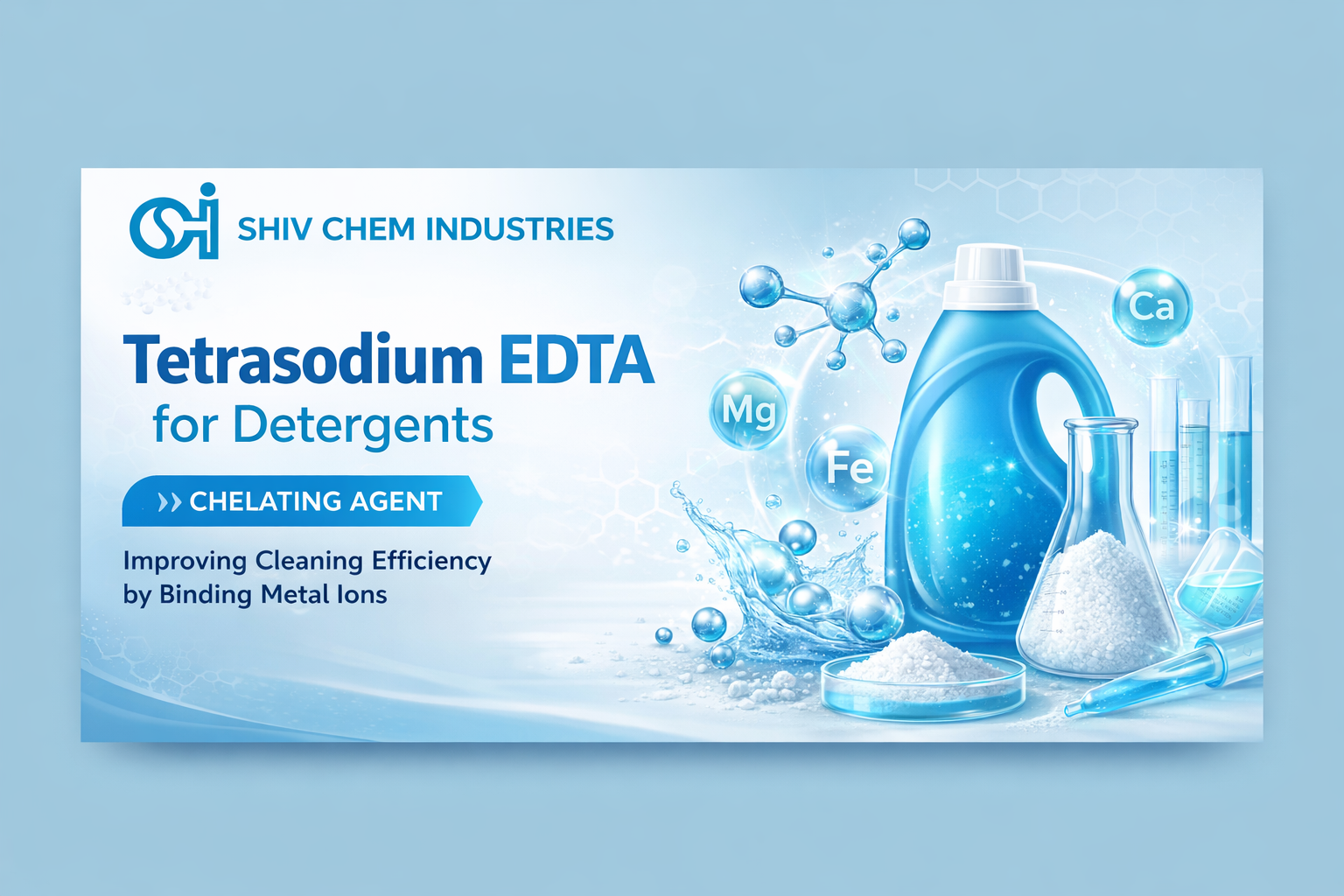
Tetrasodium EDTA for Detergents
Tetrasodium EDTA
for Detergents
Modern cleaning formulations rely on carefully balanced chemical ingredients to maintain performance, stability, and consistency across a wide range of washing conditions. Among the functional ingredients used in detergent formulations, Tetrasodium EDTA plays an important role as a chelating agent that supports the overall efficiency of cleaning products.
Tetrasodium EDTA for Detergents
Tetrasodium EDTA for detergents is widely used to control the negative effects of metal ions present in water. Minerals such as calcium, magnesium, iron, and other trace metals can interfere with the performance of surfactants and cleaning agents. By binding these metal ions, Tetrasodium EDTA helps maintain formulation stability and allows other active ingredients to function more effectively.
In both household and industrial cleaning products, detergent performance depends on maintaining chemical balance within the formulation. Chelating agents such as Tetrasodium EDTA contribute to this balance by preventing metal contamination from disrupting cleaning efficiency, product appearance, or long-term storage stability.
By binding metal ions, Tetrasodium EDTA helps maintain formulation stability and allows other active ingredients to function more effectively.
Understanding the Role of Tetrasodium EDTA in Detergent Formulations
Tetrasodium EDTA is the sodium salt of ethylenediaminetetraacetic acid and is widely used across multiple industries for its strong metal-binding capability. In detergent formulations, the compound primarily functions as a chelating agent that captures and neutralizes metal ions present in water or raw materials.
Hard water contains dissolved minerals such as calcium and magnesium. These minerals can react with surfactants and reduce the effectiveness of cleaning agents. When Tetrasodium EDTA is included in a detergent formulation, it binds with these metal ions and prevents them from interfering with the cleaning process.
By controlling metal contamination, the compound helps maintain detergent performance even in areas with hard water conditions. This improves washing efficiency, reduces the risk of unwanted residue formation, and supports consistent cleaning results across different washing environments.
Chemical Characteristics of Tetrasodium EDTA
Tetrasodium EDTA is typically produced as an off-white free-flowing powder that dissolves easily in water. The compound is known for its high chelation capacity and alkaline pH characteristics, which make it suitable for use in a wide range of cleaning formulations.
Its chemical structure allows it to form stable complexes with metal ions. Once bound, these metals remain inactive and are unable to participate in unwanted chemical reactions within the detergent system.
In detergent manufacturing, this capability is important because even trace metal contamination can influence product stability, color consistency, fragrance retention, and overall cleaning efficiency. By controlling these interactions, Tetrasodium EDTA helps maintain stable and reliable detergent formulations.
Technical Characteristics Relevant to Detergent Manufacturing
The effectiveness of Tetrasodium EDTA in cleaning products is closely related to its chemical properties and purity levels. Several characteristics make it suitable for detergent production, including high chelation efficiency, water solubility, and compatibility with common detergent ingredients.
Typical technical parameters associated with Tetrasodium EDTA include:
- High chelation capacity for binding calcium, magnesium, and heavy metal ions
- Water solubility that allows easy integration into liquid or powder detergents
- Alkaline pH characteristics that support detergent formulation chemistry
- Stability under normal storage and processing conditions
These characteristics allow detergent manufacturers to incorporate Tetrasodium EDTA into formulations where metal control and chemical stability are essential.
How Tetrasodium EDTA Improves Detergent Performance
The effectiveness of a detergent depends on the combined action of multiple ingredients such as surfactants, builders, enzymes, and stabilizers. Metal ions present in water or raw materials can disrupt this balance by reacting with active ingredients.
Tetrasodium EDTA helps prevent these reactions by binding metal ions before they interfere with the cleaning process. This improves the ability of surfactants to remove dirt, grease, and stains from surfaces or fabrics.
In addition to supporting surfactant efficiency, the compound helps prevent the formation of insoluble salts that may cause residue or deposits during washing. By maintaining chemical balance within the formulation, Tetrasodium EDTA contributes to improved washing performance and overall product stability.
Applications of Tetrasodium EDTA in Cleaning and Detergent Products
Tetrasodium EDTA is used in a wide variety of cleaning formulations where metal ion control is required. Its compatibility with different chemical ingredients makes it suitable for multiple detergent types.
Common applications in cleaning products include:
- Laundry detergents
- Dishwashing detergents
- Industrial cleaning formulations
- Surface cleaning products
- Institutional and commercial cleaning solutions
- Liquid and powder detergent formulations
In each of these applications, the compound helps maintain formulation stability and ensures that active ingredients perform effectively under varying water conditions.
Importance of Chelating Agents in Detergent Manufacturing
Chelating agents are essential components in modern detergent chemistry because they address one of the most common challenges in cleaning processes: water hardness. Hard water minerals can reduce detergent efficiency and lead to undesirable effects such as soap scum formation, reduced foaming, or residue deposits.
By incorporating chelating agents like Tetrasodium EDTA into detergent formulations, manufacturers can neutralize these minerals and maintain consistent cleaning performance. This allows detergents to function effectively across different regions where water quality may vary significantly.
The use of chelating agents also supports formulation stability during storage and transportation. By preventing metal-catalyzed reactions, Tetrasodium EDTA helps maintain the appearance, fragrance, and chemical balance of detergent products over time.
Industrial Manufacturing and Quality Control Considerations
In detergent manufacturing, maintaining consistent raw material quality is critical for achieving reliable product performance. Tetrasodium EDTA is typically produced through controlled chemical reactions involving EDTA acid and sodium compounds under carefully monitored conditions.
Quality control processes ensure that the final product meets specified parameters such as active content, chelation value, and solubility characteristics. These properties determine how effectively the compound can bind metal ions and perform within detergent formulations.
Manufacturers often conduct testing to verify purity levels and chemical stability before incorporating the material into cleaning products. Consistent quality helps ensure that detergent formulations remain stable during production, storage, and practical use.
Handling and Storage Considerations
Like many industrial chemicals used in formulation processes, Tetrasodium EDTA should be handled using appropriate safety precautions. The compound may cause irritation to the skin or eyes if handled improperly, so protective equipment such as gloves and safety goggles is typically recommended during handling.
Storage conditions also play an important role in maintaining product quality. The material should be stored in a cool, dry environment with adequate ventilation. Exposure to moisture, excessive heat, or direct sunlight can affect the stability of chemical products during long-term storage.
Packaging is commonly designed to protect the product from environmental exposure. Containers made from polyethylene or high-density polymer materials are often used to maintain product integrity during storage and transportation.
Why Tetrasodium EDTA Remains Important in Modern Detergent Chemistry
Detergent technology continues to evolve as manufacturers aim for improved cleaning efficiency, better formulation stability, and compatibility with modern washing systems. Despite advancements in formulation science, chelating agents remain an essential component in many cleaning products.
Tetrasodium EDTA continues to be used in detergent formulations because of its strong metal-binding capability and compatibility with other detergent ingredients. Its ability to stabilize formulations, improve surfactant efficiency, and prevent mineral interference makes it a valuable component in both household and industrial cleaning products.
As detergent manufacturers continue to optimize product performance, the role of chelating agents such as Tetrasodium EDTA remains an important part of maintaining formulation stability and reliable cleaning efficiency.
Product Knowledge
Frequently Asked Questions
Shiv Chem Industries
Get in Touch

Get In Touch
C-1/B, 1307/10, Road-G, Lane-5, Phase-IV, GIDC, Naroda, Ahmedabad-382330, Gujarat, INDIA.
Chelateshivchem@yahoo.co.in
info@shivchem.com
+91 9825312613, +91 98255 77277
079 22823447, +91 9558877277, +91 9574577277
Links
PRODUCTS
SHIV CHEM INDUSTRIES