
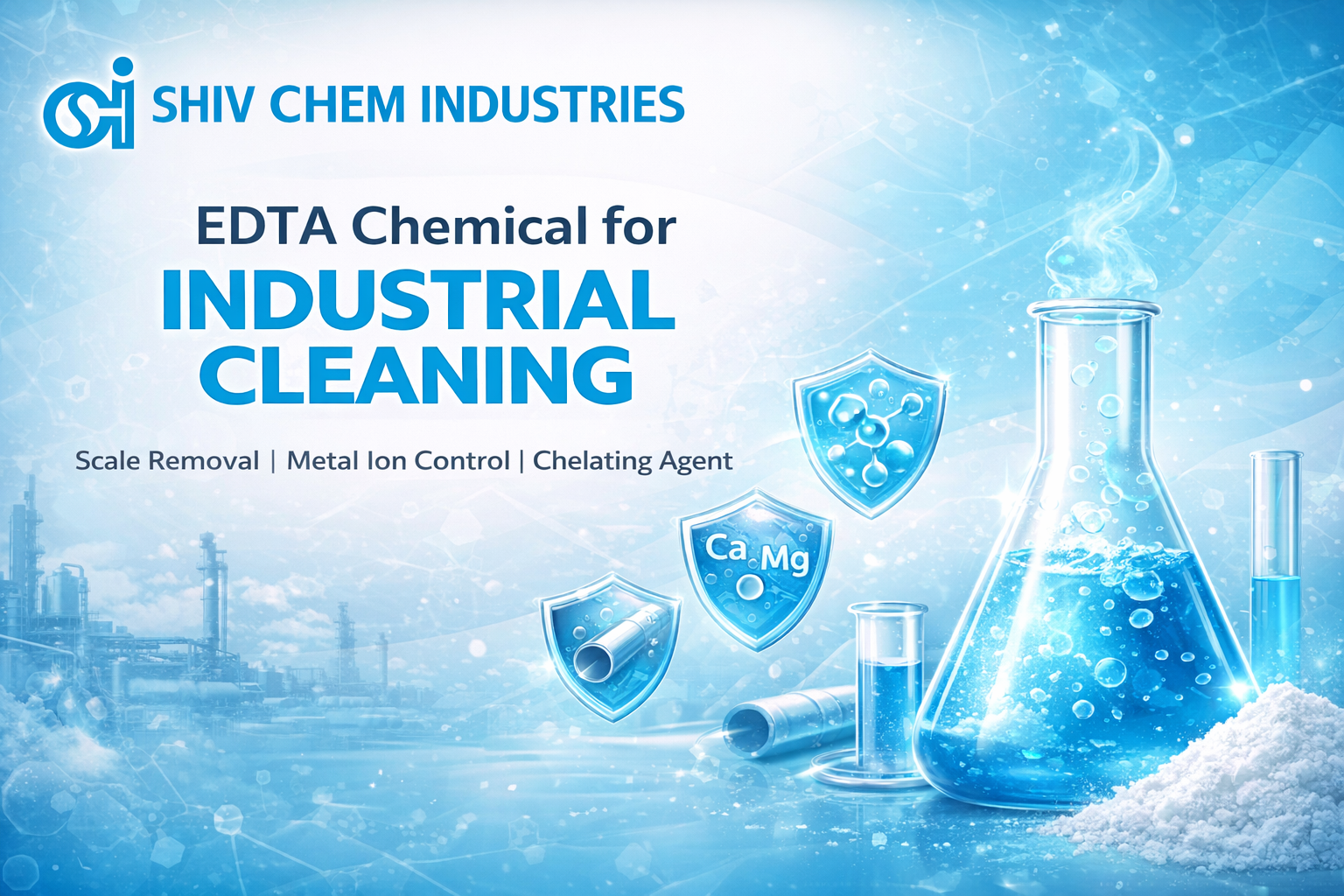
EDTA Chemical for Industrial Cleaning
EDTA Chemical for
Industrial Cleaning
Industrial cleaning processes require specialized chemicals capable of removing mineral deposits, controlling metal ions, and maintaining the efficiency of equipment used in manufacturing and processing systems. EDTA chemical for industrial cleaning is widely used in industrial environments where scale formation, metal contamination, and mineral deposits can affect the performance of pipelines, reactors, heat exchangers, and storage systems.
EDTA, chemically known as Ethylene Diamine Tetra Acetic Acid, functions as a powerful chelating agent. Its primary role is to bind with metal ions such as calcium, magnesium, iron, and copper. These ions often contribute to scale formation, corrosion deposits, and contamination within industrial systems. By forming stable complexes with these ions, EDTA helps dissolve and remove residues that accumulate during industrial operations.
Industrial facilities that rely on consistent process performance must maintain clean equipment and pipelines. When mineral scale builds up on surfaces, it can reduce heat transfer efficiency, restrict fluid movement, and increase maintenance requirements. EDTA-based cleaning chemicals help address these challenges by removing metal-based deposits and limiting the reformation of scale during cleaning cycles.
Understanding the Role of EDTA in Industrial Cleaning Processes
EDTA is widely recognized in industrial chemistry for its ability to capture and stabilize metal ions. In many industrial cleaning applications, water used in processing contains dissolved minerals such as calcium and magnesium. Over time, these minerals form deposits that accumulate on equipment surfaces and internal pipeline walls.
The molecular structure of EDTA allows it to bind strongly with these metal ions. Once captured, the ions remain dissolved in the cleaning solution rather than forming solid deposits. This property makes EDTA highly effective for removing scale and metal contamination from industrial equipment.
In circulation cleaning processes, EDTA-based solutions are often used to flush pipelines, tanks, and processing units. As the cleaning solution moves through the system, it reacts with metal ions and helps dissolve scale layers that develop during production cycles. This process improves system cleanliness and supports the restoration of operational efficiency.
Importance of Chelating Agents in Industrial Maintenance
Chelating agents play a critical role in industrial cleaning because many types of contamination originate from metal ions present in water or raw materials. These ions can react with other chemicals and form insoluble deposits that are difficult to remove using conventional cleaning agents.
EDTA chemical for industrial cleaning provides an effective solution by stabilizing these metal ions and preventing them from forming unwanted compounds. This capability improves the performance of cleaning formulations used across multiple industrial sectors.
Industrial cleaning chemicals often combine EDTA with other components such as surfactants, dispersing agents, and alkaline or acidic compounds. Together, these ingredients create cleaning solutions capable of removing both organic and inorganic contaminants from equipment surfaces.
Industries that rely on precise process control benefit from the use of chelating agents because they help maintain stable operating conditions and reduce the risk of equipment damage caused by mineral deposits.
Industrial Systems Where EDTA Cleaning Chemicals Are Commonly Used
Industrial cleaning operations occur across a wide range of manufacturing and processing facilities. Equipment exposed to high temperatures, mineral-rich water, or metal-containing raw materials often requires periodic cleaning using chelating agents.
Common industrial systems where EDTA-based cleaning chemicals are applied include:
- Heat exchangers and cooling systems
- Industrial boilers and water circulation pipelines
- Chemical processing reactors and vessels
- Storage tanks used for raw materials and intermediates
- Industrial filtration and membrane systems
- Textile processing equipment and dyeing units
- Metal finishing and electroplating systems
These systems can accumulate scale, corrosion residues, or metal-based contamination during operation. The use of EDTA cleaning chemicals helps dissolve these deposits and restore normal process conditions.
How EDTA Helps Remove Mineral Scale and Metal Deposits
Mineral scale is one of the most common maintenance challenges in industrial operations. When water containing dissolved minerals is heated or evaporated, solid deposits form on equipment surfaces. These deposits typically consist of calcium carbonate, magnesium salts, or metal oxides.
EDTA chemical for industrial cleaning works by forming stable complexes with the metal ions present in these deposits. Once the ions bind with EDTA molecules, the structure of the scale gradually breaks down and dissolves into the cleaning solution.
The ability of EDTA to keep metal ions dissolved prevents redeposition during the cleaning process. This ensures that dissolved minerals remain suspended in the cleaning solution until they are flushed out of the system.
By removing scale layers from surfaces such as heat exchanger plates or boiler tubes, EDTA cleaning processes help restore heat transfer efficiency and reduce energy consumption in industrial systems.
Industrial Cleaning Process Using EDTA-Based Chemicals
In many facilities, industrial cleaning is performed using controlled circulation cleaning procedures. EDTA-based cleaning chemicals are introduced into the system and allowed to circulate for a specific period while reacting with metal deposits and scale layers.
Typical industrial cleaning processes involve the following steps:
- Preparation of EDTA cleaning solution at the required concentration
- Circulation of the cleaning solution through equipment or pipelines
- Chemical interaction with metal ions and scale deposits
- Monitoring of cleaning effectiveness during the process
- Final flushing of the system to remove dissolved residues
Advantages of EDTA in Industrial Cleaning Formulations
EDTA remains one of the most widely used chelating agents in industrial chemistry because of its reliable metal-binding capability and chemical stability. These properties make it suitable for a wide range of industrial cleaning formulations.
Key advantages of EDTA chemical for industrial cleaning include:
- Strong chelation of calcium, magnesium, and other metal ions
- Effective removal of scale from industrial equipment
- Improved efficiency of chemical cleaning formulations
- Prevention of metal ion interference in process chemistry
- Compatibility with various industrial cleaning systems
These advantages contribute to improved equipment performance and more stable industrial operations.
Industries That Use EDTA Cleaning Chemicals
Many industrial sectors require cleaning agents capable of managing metal contamination and mineral deposits. EDTA-based chemicals are widely used in industries where equipment cleanliness is essential for maintaining process stability.
Industries that commonly use EDTA cleaning chemicals include chemical manufacturing, textile processing, pharmaceuticals, paper production, electroplating, water treatment systems, and detergent manufacturing. In these sectors, EDTA helps maintain operational efficiency by removing metal-based residues that accumulate during production processes.
Because EDTA interacts with a broad range of metal ions, it provides versatile cleaning performance across different industrial environments.
Role of EDTA in Process Efficiency and Equipment Maintenance
Maintaining clean equipment is essential for stable industrial operations. Deposits that accumulate inside pipelines, reactors, or heat exchangers can disrupt process flow and reduce equipment performance. EDTA chemical for industrial cleaning supports maintenance activities by dissolving metal-based residues that may otherwise become difficult to remove.
Regular cleaning using chelating agents can extend the service life of industrial equipment by preventing corrosion and scale buildup. When cleaning cycles are properly managed, facilities can reduce downtime, maintain consistent process quality, and minimize unexpected maintenance issues.
For this reason, EDTA cleaning chemicals are often included as part of preventive maintenance programs in many industrial facilities.
Environmental Considerations in Industrial Cleaning Chemicals
Industrial chemical processes increasingly emphasize environmental responsibility and controlled chemical usage. EDTA-based cleaning chemicals must be handled according to established safety and disposal guidelines to support responsible environmental management.
Modern industrial cleaning practices focus on optimized chemical dosing, controlled cleaning cycles, and proper wastewater treatment to manage chelating agents effectively. When these practices are implemented, industrial facilities can maintain operational efficiency while meeting environmental compliance requirements.
As industrial production continues to evolve, the demand for reliable cleaning chemicals that balance performance with responsible chemical management remains an important consideration in modern manufacturing.
Frequently Asked Questions
Get In Touch

Get In Touch
Ahmedabad Office :-
C-1/B, 1307/10, Road-G, Lane-5, Phase-IV, GIDC, Naroda, Ahmedabad-382330, Gujarat, INDIA.
Ahmedabad Phone :- +91 9825312613, +91 98255 77277
Ahmedabad Landline :- 079 22823447
Ahmedabad Email :- info@shivchem.com
Mumbai Office :-
B-004, Poornima Apts, 23 Pedder Road, Mumbai - 400026, Maharashtra.
Mumbai Phone :- +91 98210 38627
Mumbai Landline :- 022 23523091, 022 23520235
Mumbai Email :- hiren@tradelinkss.com
Links
PRODUCTS
SHIV CHEM INDUSTRIES