
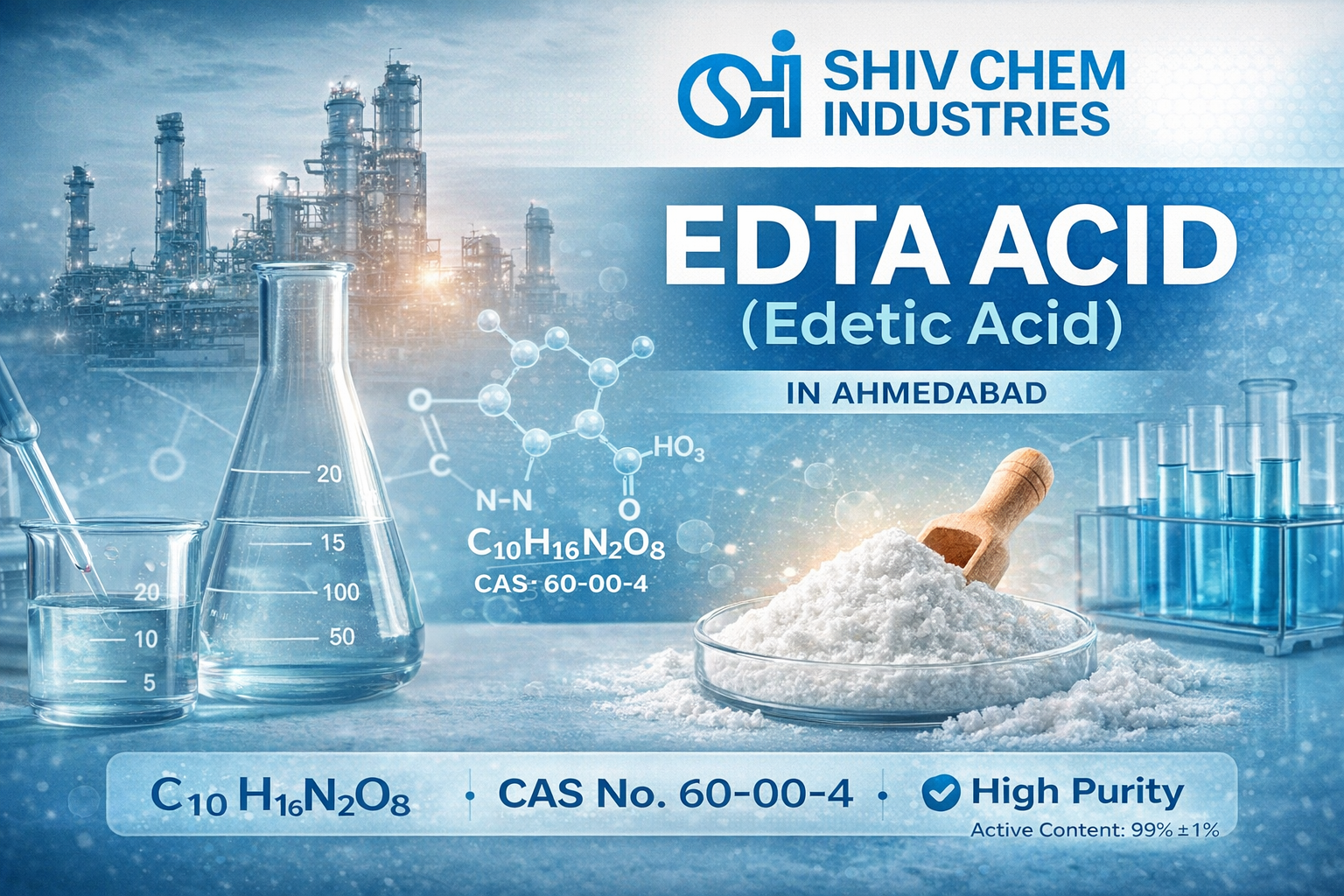
EDTA Acid (Edetic Acid) in Ahmedabad
EDTA Acid (Edetic Acid)
in Ahmedabad
Industrial chemical manufacturing in Ahmedabad depends on consistent raw material quality, particularly in processes involving metal ion control and formulation stability.
EDTA Acid (Edetic Acid) in Ahmedabad
EDTA Acid (Edetic Acid) in Ahmedabad plays a critical role in industries where chelation performance directly affects product quality and operational efficiency. As a widely used sequestering agent, EDTA acid supports key sectors across Gujarat's industrial ecosystem, including chemical processing, textiles, pharmaceuticals, and electroplating.
Shiv Chem Industries, located in Phase IV, GIDC Naroda, Ahmedabad, has been manufacturing EDTA Acid since 1987. Operating from an established industrial facility, the company supplies EDTA-based chelating agents to both domestic and export markets. With structured production systems and defined quality testing protocols, the focus remains on maintaining chemical consistency and purity suitable for demanding industrial applications.
Understanding EDTA Acid (Ethylenediaminetetraacetic Acid)
EDTA Acid, chemically known as Ethylenediaminetetraacetic Acid, is a synthetic amino acid and a hexadentate ligand. Its molecular formula is C??H??N?O? and its C.A.S. No. is 60-00-4. In industrial form, it appears as a white, free-flowing powder. Although insoluble in water, it forms a clear, colorless solution when dissolved in sodium hydroxide.
As a chelating agent, EDTA acid binds with metal ions such as calcium, magnesium, iron, and other trace metals. This binding action prevents unwanted reactions caused by free metal ions during chemical processing. Because of this property, EDTA acid is widely used as a stabilizing and sequestering compound across multiple industries.
Raw materials used in its production typically include monochloroacetic acid, sodium carbonate, sodium hydroxide, ethylenediamine, and hydrochloric acid. Certain international manufacturing routes may involve formaldehyde and sodium cyanide, which can result in trace impurities such as Nitrilo Tri Acetic acid. Controlled production practices help ensure higher purity levels and reliable industrial performance.
Technical Specifications of EDTA Acid
The technical characteristics of EDTA Acid manufactured in Ahmedabad include:
| Parameter | Value |
|---|---|
| C.A.S. No. | 60-00-4 |
| Chemical Formula | C??H??N?O? |
| Physical Appearance | Powder |
| Color | White |
| Molecular Weight | 292.24 |
| Active Content | 99.0% ± 1.0% |
| Chelation Value | Minimum 335.0 |
| pH (0.05% w/v) | 2.0 to 3.0 |
| Solubility | Insoluble in water; 20% Sodium Hydroxide solution is clear and colorless |
These parameters are essential for industrial buyers who require defined purity standards and predictable chemical behavior in controlled manufacturing environments.
Industrial Applications of EDTA Acid in Ahmedabad
Ahmedabad, particularly industrial zones such as Naroda and Vatva GIDC, hosts a broad range of manufacturing units. EDTA Acid in Ahmedabad is used in industries such as:
In textile processing, EDTA acid helps control water hardness and improves dye uniformity. In electroplating, it stabilizes metal ions and enhances deposition consistency. In pharmaceutical formulations, it contributes to stability where controlled metal ion presence is required.
Role of EDTA Acid in Metal Ion Control
Metal ions present in water or raw materials can interfere with industrial reactions. These ions may cause discoloration, reduce product stability, or affect reaction efficiency. EDTA acid forms stable complexes with these metals, effectively reducing their reactivity.
This chelation mechanism helps maintain the desired chemical balance in formulations. For instance, in detergent manufacturing, EDTA enhances cleaning efficiency by softening water. In pigment production, it prevents unwanted precipitation and supports uniform product quality.
Industrial Demand for EDTA Acid in Gujarat
Gujarat is one of India's leading chemical manufacturing states. With major industrial clusters in Ahmedabad, Vadodara, Surat, and Ankleshwar, the demand for reliable chelating agents remains consistent. EDTA Acid in Ahmedabad serves as a key input for numerous downstream industries operating within and beyond the state.
Naroda GIDC, where Shiv Chem Industries is based, is recognized for its concentration of chemical and pharmaceutical units. Local availability of EDTA acid supports streamlined supply chains and reduces logistical dependency for manufacturers across Gujarat's industrial corridors.
Handling and Safety Guidelines
EDTA acid and its concentrated solutions may cause irritation to the skin and eyes. Adhering to proper industrial handling procedures is essential for maintaining workplace safety.
- Use protective goggles, gloves, and safety footwear during handling
- Avoid direct contact with skin and eyes
- In case of spillage, rinse the affected area with sufficient water
- For skin exposure, wash thoroughly with neutral soap and water
- Seek medical attention if irritation persists
Following established chemical safety practices minimizes risks during storage, handling, and application.
Storage Requirements
EDTA Acid should be stored in a cool, dry, and well-ventilated environment. Exposure to direct sunlight, heat sources, or moisture should be avoided to maintain product stability. Suitable storage containers include polyethylene, polypropylene, or high-density polyethylene materials.
Proper storage conditions help preserve active content and prevent contamination, which is critical for industries that rely on consistent chemical specifications.
Packaging Standards
EDTA Acid is typically packed in 25 kg HDPE bags or paper bags with an inner polyethylene liner. Customized packaging options may be arranged based on specific industrial requirements. Secure packaging helps protect the material from moisture and environmental exposure during transportation and storage.
Why Industrial Buyers Evaluate EDTA Quality
When sourcing EDTA Acid in Ahmedabad, industrial buyers commonly assess:
- Active content percentage
- Chelation value
- Purity and absence of unwanted impurities
- Batch-to-batch consistency
- Accurate labeling and technical documentation
Manufacturing Experience and Process Stability
Since 1987, Shiv Chem Industries has been engaged in the production of EDTA Acid and related chelating agents. Industrial chemical manufacturing requires controlled reaction parameters, consistent raw material monitoring, and batch-wise quality testing to maintain defined specifications.
Stable chemical properties are critical because EDTA is often used in formulations where even minor variations can impact end-product performance. Structured production systems and clearly defined technical standards help support long-term industrial requirements.
EDTA Acid and Environmental Considerations
In several industries, EDTA acid is used to manage heavy metal presence in wastewater and process streams. By forming stable complexes, it helps reduce uncontrolled metal reactions. However, industries must comply with applicable regulatory guidelines for discharge and treatment to ensure environmental responsibility.
Controlled dosing, responsible handling, and adherence to environmental regulations are important when using chelating agents in large-scale industrial processes.
Frequently Asked Questions

Get In Touch
C-1/B, 1307/10, Road-G, Lane-5, Phase-IV, GIDC, Naroda, Ahmedabad-382330, Gujarat, INDIA.
Chelateshivchem@yahoo.co.in
info@shivchem.com
+91 9825312613, +91 98255 77277
079 22823447, +91 9558877277, +91 9574577277
Links
PRODUCTS
SHIV CHEM INDUSTRIES