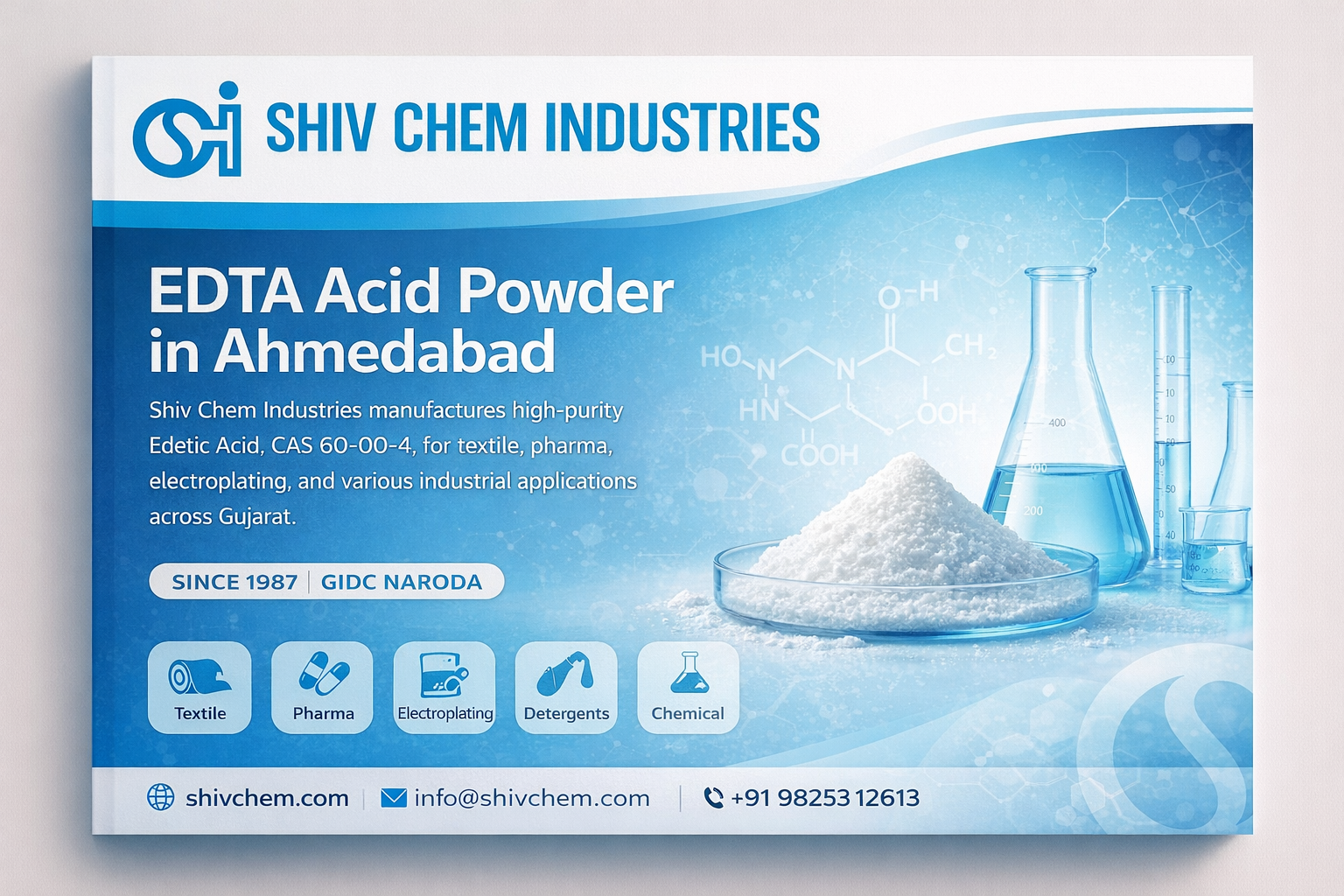
EDTA Acid Powder in Ahmedabad | Shiv Chem Industries
Shiv Chem Industries · GIDC Naroda, Ahmedabad · Est. 1987
EDTA Acid Powder in Ahmedabad
Industrial manufacturing and chemical processing units in Ahmedabad require technically consistent chelating agents to maintain formulation stability, process efficiency, and product quality.
EDTA Acid Powder in Ahmedabad
EDTA Acid Powder in Ahmedabad plays an important role in industries where metal ion control directly influences operational performance. From textile processing to pharmaceuticals and electroplating, the demand for high-purity chelating compounds continues to expand across Gujarat's industrial ecosystem.
Shiv Chem Industries, established in 1987 and located in GIDC Naroda, Ahmedabad, manufactures EDTA Acid (Edetic Acid) for domestic and export markets. The company follows controlled production processes, systematic quality testing, and standardized packaging practices to ensure uniformity across industrial applications. With decades of manufacturing experience, it supplies EDTA-based chelating agents to sectors that depend on reliable and consistent chemical performance.
Understanding EDTA Acid (Edetic Acid)
EDTA Acid, chemically known as Ethylenediaminetetraacetic Acid, is a synthetic amino acid widely used as a chelating or sequestering agent. It carries the chemical formula C??H??N?O? and C.A.S. No 60-00-4. In its pure form, it appears as a white, free-flowing powder with high active content.
As a hexadentate ligand, EDTA Acid can bind metal ions such as calcium, magnesium, iron, and other heavy metals. This binding action helps prevent undesirable reactions caused by metal contaminants in industrial systems. The chelation mechanism improves formulation stability, enhances process control, and supports consistent end-product quality.
Technical Specifications of EDTA Acid Powder
The quality of EDTA Acid Powder in Ahmedabad is verified through standardized testing procedures and controlled manufacturing parameters. A typical technical profile includes:
Parameter
Value
C.A.S. No
60-00-4
Chemical Formula
C??H??N?O?
Physical Appearance
White powder
Molecular Weight
292.24
Active Content
99.0% ± 1.0%
Chelation Value
Minimum 335.0
pH (0.05% w/v)
2.0 to 3.0
Solubility
Insoluble in water; clear and colorless in 20% Sodium Hydroxide solution
These defined properties make EDTA Acid suitable for industrial environments where precise chemical control and stability are required.
Manufacturing Considerations and Raw Materials
The production of EDTA Acid involves carefully controlled chemical reactions using raw materials such as monochloroacetic acid, sodium carbonate, sodium hydroxide, ethylene diamine, and hydrochloric acid. The selected manufacturing route directly influences purity levels and impurity control.
Certain global manufacturing methods use formaldehyde, ethylene diamine, and sodium cyanide or hydrogen cyanide, which may introduce trace levels of Nitrilo Tri Acetic Acid as an impurity. Maintaining strict process discipline and continuous quality monitoring helps ensure the final product meets industrial-grade standards with minimal unwanted residues.
Industrial Applications of EDTA Acid Powder
EDTA Acid Powder in Ahmedabad is widely used across industries due to its strong metal-binding capacity and ability to stabilize formulations. Its application depends on the need to control hardness ions, prevent scale formation, or maintain chemical balance in process systems.
Major industrial applications include:
Textile processing, including bleaching, dyeing, kier boiling, and scouring
Soap and detergent manufacturing for hardness control
Pharmaceutical formulations as an antioxidant and antibacterial synergist
Paper and pulp processing
Electroplating industries for metal ion stabilization
Rubber processing
Photography chemicals
Leather treatment processes
Agricultural micronutrient formulations
Cosmetic formulations
Paint and pigment manufacturing
Rayon production
Polymerization processes
In each of these sectors, EDTA Acid supports predictable chemical reactions by neutralizing interfering metal ions.
Role of EDTA Acid in Textile and Detergent Industries
Ahmedabad has a well-established textile and chemical manufacturing base. In textile processing, water hardness and trace metal contamination can affect dye uptake, fabric brightness, and overall finish quality. EDTA Acid binds these metal ions, reducing shade variation and minimizing process inefficiencies.
In detergent manufacturing, chelation improves cleaning performance by neutralizing calcium and magnesium ions present in hard water. This enhances surfactant efficiency and helps maintain consistent formulation quality.
Importance in Pharmaceutical and Electroplating Applications
In pharmaceutical formulations, EDTA Acid functions as a stabilizing and chelating agent. It enhances preservative effectiveness and helps prevent degradation caused by metal-catalyzed oxidation. Its use requires adherence to defined quality standards and regulatory guidelines.
In electroplating operations, stable metal ion concentration is essential for achieving uniform coating thickness and surface finish. EDTA Acid contributes to bath stability, supports controlled deposition, and improves plating efficiency.
Handling and Safety Guidelines
Proper handling of EDTA Acid Powder is necessary due to its irritant properties. Industrial users should implement appropriate safety protocols to minimize exposure risks.
Use protective goggles, gloves, and safety footwear
Avoid direct skin or eye contact
Do not handle with hooks or sharp tools that may damage packaging
In case of spillage, wash the area thoroughly with water
In case of skin contact, wash with neutral soap and water
Seek medical attention if irritation persists
Adhering to these precautions ensures safe handling within manufacturing facilities.
Storage and Packaging Standards
EDTA Acid Powder should be stored in a cool, dry, and well-ventilated environment. Protection from direct sunlight, excessive heat, and moisture is essential to maintain product stability.
It is typically stored in containers made of or lined with polyethylene, polypropylene, or high-density polyethylene. Standard packaging includes 25 kg HDPE bags or paper bags with polyethylene liners, depending on customer requirements.
Proper storage conditions help preserve active content and chelation efficiency over time.
Why Ahmedabad is a Strategic Hub for Chemical Manufacturing
Ahmedabad, particularly industrial zones such as GIDC Naroda, is a prominent hub for chemical manufacturing in Gujarat. The region offers access to skilled labor, raw materials, industrial infrastructure, and strong logistics connectivity. This ecosystem supports the consistent production of specialty chemicals, including EDTA Acid Powder.
Manufacturers operating from Ahmedabad cater to both domestic industries and export markets. The presence of established testing laboratories and structured supply chains supports quality compliance and timely distribution.
Quality Control and Industrial Reliability
For industries that rely on chelating agents, consistent quality is essential for stable operations. Batch-wise testing, purity analysis, and chelation value verification contribute to reliable product performance. Documentation, traceability, and standardized packaging further reinforce industrial confidence.
Selecting a manufacturer with long-term production experience and stable process controls helps ensure uninterrupted supply and predictable chemical behavior across applications.
Frequently Asked Questions
EDTA Acid Powder is primarily used as a chelating agent in textile processing, detergents, pharmaceuticals, electroplating, paper, rubber, cosmetics, and other industries where metal ion control is required.
EDTA Acid is insoluble in water in its free acid form. However, it dissolves in alkaline solutions such as sodium hydroxide, forming clear and colorless solutions.
Its high active content, strong chelation value, and ability to bind multiple metal ions make it effective for stabilizing industrial formulations and preventing unwanted chemical reactions.
It should be stored in a cool, dry, and well-ventilated area, protected from heat, sunlight, and moisture, in polyethylene or HDPE-lined containers.
It should be handled using appropriate protective equipment. Direct contact may cause irritation to the skin and eyes, so standard industrial safety precautions must be followed.
Yes, it is identified by C.A.S. No 60-00-4 and is commonly known as Ethylenediaminetetraacetic Acid or Edetic Acid.
Conclusion
EDTA Acid Powder in Ahmedabad plays a foundational role in industrial processes where metal ion control and formulation stability are critical. With clearly defined chemical specifications, high chelation value, and a broad application range, it supports textile manufacturing, pharmaceuticals, electroplating, detergents, and other specialty chemical operations.
Manufactured in established industrial zones such as GIDC Naroda, Ahmedabad, EDTA Acid remains an essential chelating agent for industries across Gujarat and India. Consistent quality control, proper handling practices, and structured storage conditions contribute to its dependable performance in demanding chemical environments.